Tuesday, November 22, 2011

my name is judge.


If you haven't already caught wind of the media outrage regarding the recently released Tokidoki Barbie, here are a few articles to catch you up:


Parents and conservatives the blogosphere over have been voicing their disdain for the collectable doll, who sports a funky outfit and an assortment of brightly colored, Asian-inspired tattoos all across her body. In each article you'll find quoted parents and community members spouting a variety of reactions to news of the toy's appearance on store shelves. These snippets, however, are tame compared to the heated responses found in the comments sections below the articles themselves. I've been sifting through them for hours now, and am quite exhausted by the back and forth between the defenders and the haters. Many of those who oppose the sale of an inked up Barbie are quick to reference stereotypes of tattooed folk as criminals and druggies, yet others seem to have delved a bit deeper and come up with some thought-provoking points. What really captured my attention were the comments regarding how tattooed individuals are judged. They made me consider not just how modders are judged by mainstream society, but also by those within the body modification community itself.
Although we (modders) don't like people to make snap judgements about us based solely on the fact that we sport body art, I have seen evidence that we from time to time make similar judgements about fellow modders who sport certain types of tattoos. I'm not attempting to claim here that everyone in the body mod community is judgmental, but if you can recall your first time in a tattoo shop you might be able to see where I'm going with this. More than a few tattoo artists I know can be quite condescending toward the newly initiated modders amongst us, and I kinda don't blame them. I mean, imagine being a talented tattoo artist running your own high-end shop, and one day an 18 year-old girl comes in asking you for a tribal sun - or worse, her boyfriend's name - on her lower back. You'd probably find it damn difficult to suppress an eye roll and a sigh. Tattoo artists are becoming fine artists of the skin, resulting in an unavoidable sense of disdain for anyone with, or who aims to acquire, a poor quality or generic tattoo. Heck, there are even tattoo artists out there who specialize in the New Skool style and think those covered in Old School designs are just plain lamesauce. There are many qualities of one's ink that can evoke a measure of contempt from fellow inked, including but not limited to motivation for obtaining the tattoo, location of the tattoo, subject matter of the tattoo, quality of the tattoo, significance of the image/words, and artistic style of the tattoo. Now the question must be raised, how can we so readily judge others by their ink when we wish not to be judged by ours?
The answer, in my opinion, lies in the fact that body modification has not yet gained full societal acceptance. When a professional, licensed body piercer sees a botched, infected eyebrow piercing that is pussing and rejecting, they will understandably scorn the wearer as a contributor to a negative perception of body piercing as dangerous and repulsive by society at large. Similarly, the gent who indelibly self-scratches a tattoo loosely resembling barbed wire across his forehead will undoubtedly get a rise out of the veteran tattoo artist who has spent decades perfecting his art and craft. We simply can't be expected to respect those whose body projects contribute to perpetuating a negative image for body modification as a whole.
Granted, widespread acceptance of mods is not necessarily something that every modded individual hopes for. Indeed, part of the allure of modifying our bodies is that we can thereby differentiate ourselves from the rest of society. If everyone accepted and practiced body modification, it might not be so appealing anymore. Additionally, many modders agree that people who immediately judge their character based on their being modded probably don't fit the bill for friendship anyway. In this sense, mods are a "friend filter," as one commenter put it. However, when it comes to acceptance of mods by prospective employers, we can't help but give a damn. If I am better qualified for a particular job than the plainskin next to me, and he gets hired, it becomes clear that there is certainly reason for someone like me to care about how society views mods. Thus, for fellow modded job-seekers, judging those with sub-par mods is somewhat of a self-serving instinct.
Despite this justification for judgement, I still don't condone holding those with inferior mods in contempt. It may be inevitable that I dislike certain mods themselves, but no matter how ugly in my eyes they may be prized possessions in the eyes of their beholder. Thus, I consider it my responsibility to try and cut the thought process short before disdain for a mod becomes disdain for a person himself. We must remember that no matter how tattered and torn, some books hold much more beauty inside than might be suggested by their covers.

Wednesday, November 09, 2011

getting older ain't so bad, but growing up sucks


Wow, has it really been a year?! Jeebs, MSOM, I've missed you. That's why I've come back out of hiding to lay down yet another of my body mod musings.
San Francisco has been incredibly good to me since moving here 3 years ago, but it sure is distracting. So many wonderful diversions! Recently, though, I've begun to settle back into a slightly calmer lifestyle of homemade dinners, Friday nights in, and yes, even reading a novel or two in my spare time. Am I growing up? Nah, not anytime soon. Not in the traditional sense, at least. I am, however, going through a bit of a quarter-life crisis that has me thinking more than ever before about my health and well-being. That youthful period of whimsicality and fearlessness has begun to fade and in it's place lies a newfound sense of anxiety about the many potential harms that can come to us at any given moment. Don't worry, I haven't developed Agoraphobia or anything. I have, however, begun to monitor my health more intently than ever. I've experienced a number of disconcerting medical symptoms over the last year, and with a history of cancer in my family, I've spent much of the year worrying about disease. However, in the last month or so I have finally decided that I will no longer add the stress of worry to the numerous features of my fast-paced life that could potentially lead to illness. If I'm worried about illness, and illness can be exacerbated by worry...that cycle needs to be ended ASAP.
Ok, so, where does body modification fit into all this?


Well, about two months ago, I got two beautiful new microdermals (dermal anchors) installed below my clavicles. I was excited to have new piercings, as it had been a few months since I removed my sternum dermal. A week in, after daily sea-salt soaks and lots of TLC, they were looking quite good. Unfortunately, that didn't last long. I made the mistake of wiping them dry with a piece of toilet paper - big no-no when it comes to piercings. The preferred cloth to use on healing piercings is paper towel, as it doesn't leave a residue of microscopic dust like toilet paper and doesn't harbor bacteria like cloth towels. Even knowing this, I lazily decided to use TP instead of going downstairs to get a paper towel. D'oh. Literally hours after using the TP, my piercings both grew very angry (i.e. red and swollen). I happened to see my piercer that day, and asked him for some guidance on how to calm them down. He asked if anything out of the ordinary had happened to them, and I was embarrassed to tell him that I had used the TP. I instead told him that they had just started looking like that on their own. He advised me not to touch them for a little while and just leave them be, so naturally I stopped all aftercare including soaking. Mistake #2. Without being soaked the piercings were not draining the fluid that had accumulated within the wound as a result of the irritating toilet paper dust. They swelled up and got very sensitive, as did my lymph nodes - and that spells infection. Upon seeing the updated status of my dermals, my piercer chastised me and told me to start soaking them twice a day. I have to admit, I felt pretty shitty upon walking out of his shop that day. I like to think of myself as pretty piercing-savvy, so I was embarrassed that I had made as amateur a mistake as allowing them to get infected.
Little did I know I would feel a helluva lot shittier upon leaving my ENT's office the next day after going in to get my glands checked out. One word: biopsy.
The word itself gives me shivers. No one wants to have a biopsy - to sit fidgeting anxiously in the waiting room, to endure days or even weeks of mental distress while waiting for results - it's not exactly a fun procedure, and my case wasn't any exception. There I sat with a 4-inch needle embedded in my neck for a full 3 minutes as the technician wiggled it around in an attempt to get a sample. Let me tell you: it felt fucking bizarre. I get squeamish at just the thought of it.
Thankfully, the results came back negative. I am completely healthy aside from the swollen glands - a sign that my body had been fighting an infection. However, both my ENT and the woman who performed the biopsy made sure to advise me to remove my irritated metal friends ASAP if I wanted my glands to go back to normal. They said that the dermals were putting unnecessary strain on my immune system and could result in my getting sick easier that usual. Any body modification practitioner would agree that piercings, tattoos, scarification, branding, suspension, etc. are not exactly beneficial to one's health, especially when the wounds are not properly cared for. I knew this as well, but had always thought it a moot point if I wanted to continue to test my body's limits and ornament it via body modification. Now I'm getting older, and those warnings no longer seem so irrelevant.
At that point I knew I should take the piercings out, but I stubbornly tried to heal them for a few more weeks. To my dismay, they eventually became unbearably tender and didn't seem to be encouraged even by daily soaks anymore. It was finally time to make the dejected trip to get them removed.
Regardless of what my doctors told me, I probably would have gotten the dermals out at about the same point in time anyway. They were ready to go. What my encounters with my doctors did alter, however, is my stance on whether or not to get the (very expensive) microdermal jewelry autoclaved and re-embedded in my body at some point in the future. I think...and it hurts to say this...but I think I may be over dermal anchors. Once so fun and exciting in that they could be placed nearly anywhere and were virtually painless to insert and remove, they now seem to me a risky and annoying bodily adornment that just isn't worth the gamble nor the hassle.
Thankfully, I don't quite think I'm done with piercings altogether, and I'm told that the white gold fire opal disc from one of the anchors can be be set onto a nostril screw. This means I might finally go for the double nostrils I've been contemplating for over a year! Judging by the large number of successful nostril piercings I've seen on SF denizens young and old, they seem to have a pretty low risk of complication or infection compared to other piercings. Oh the nostril piercing, how vanilla. At least I'd be getting two of them...
Now, I may be starting to go the less-risky route when it comes to body modification, but I certainly won't be giving up my motorcycle or snowboard anytime soon. I'm also still quite the hardy partier here in SF (tough not to be), and I enjoy staying out into the wee hours of the morning from time to time. In exchange for maintaining these venturesome features of my lifestyle, I've got to start making some sacrifices insofar as other risky behaviors in my life go. I'm relieved that doing so won't mean giving up on body piercing altogether, as it will always be a source of fascination and intrigue for me, but it will mean becoming more tame in my piercing conquests. That, I think I can handle.

Saturday, December 25, 2010

of microdermals and men


Iii got a new pierrrcing! Went in intending to get the double nostrils I've been lusting after for years and somehow emerged with an over-the-eyebrow microdermal! It's a truly stunning piece of jewelry - a tiny shimmering opal stone set in elegant white gold. It swelled for only a few hours post-procedure, and despite being only 3 days old it already feels healed. Man I love microdermals! This is my second one and I find them insanely easy to care for and adapt to having. Unfortunately, my man doesn't feel the same.
When I first got my sternum pierced with a beautiful moonstone microdermal I was on a high all day long. I waited anxiously for my man to get home so I could show off my sparkly new ta-ta accessory. Much to my dismay, he wasn't all that psyched about it. He worried about ripping it out during playtime or inadvertently whacking it while we slept. I felt bad for a moment when he expressed these concerns - I hadn't really thought about how my piercing would affect him when I decided to get it. Had my decision been selfish? Well, over time we both adapted to my new bling, and 7 months later it is well healed and neither of us barely even notice it anymore. I carefully avoid it when using a loofah in the shower and he is sure to concentrate his titty-love on the goods themselves. It is never a problem, and he's totally over the initial worry.
Unfortunately, just as we both got used to my sternum dermal, here I go getting a facial dermal. D'oh. Once again I failed to consider my mate when getting a new mod. The nostrils he would have been okay with, considering how much smaller and out-of-the-way they are. However the brow dermal makes snuggling up to his chest less of a spontaneous and more of a calculated act, and it complicates his frequent efforts to lovingly brush hair out of my eyes. Here we go again.
After 3 days with the piercing, things luckily seem ok. Once again the bling did take a bit of getting used to, but neither of us have yet bumped or pulled on it with any great force. Now that my babe's concern has been yet again quelled through a bit of a test-run, I've begun to wonder just how much weight I should put on his opinions as to what new mods I'll acquire in the future. He has a few tattoos and no piercings, so I believe that his reservations about me getting new metal can be attributed in part to his lack of understanding as to why I even want mods in the first place. Aesthetic value is of course one of the more easily understood justifications, but he sees me as "fine the way I am," and doesn't feel that I need to add to my appearance to improve it. I have explained some of the other reasons for my desire to become ever-more modded, and although he respects this desire he still fails to fully understand it. What are we, as modded folk, to do when our significant others just don't get it? And even worse, what are we to do when we are made to feel guilty for getting new mods due to the fact that they affect not just us but also our loved ones?
This is how I see it:
Yes, I am willingly acquiring newly sensitive areas of the body that he will have to avoid, but - well - I want them anyway! I love piercings, and although at first we both need to learn to avoid them it's never really that difficult a task. It's as if our brains re-wire or something, creating a new map of the body that includes the piercing as a no-touch zone. He wouldn't stick a finger in my eyeball, and I tryyyy not to knee him in the balls - is this the same thing? Or what about sensitive emotional issues - there are certain things that I know not to talk about around him out of respect for his sensitivity to those things. Just as in the case of my new piercing, he acquired that sensitivity somehow, and with some effort could probably remove it. Granted, emotional issues aren't exactly voluntarily acquired, but they are particular to each person and are to be avoided out of respect for that person.
We can't tell anyone else how to live or dress or speak - we are all our own people and must recognize that every day we deal with people who are very different than us. We may have to stand up to certain people, or be extra gentle when interacting with others. Life is one big compromise, where you bend to other people's needs hoping they will also bend to yours when the time comes. My man is absolutely wonderful and I'm lucky to have him, but he's not perfect. There are certain traits of his that I deal with on a daily basis, and do so happily because I love all that he is. Sometimes I want to freak out on him for leaving his dirty socks all over our bedroom, but instead I pick them up and poke fun at him for doing it. In return he turns off the heat when I've forgotten to, and fixes my motorcycle when I'm too pouty about my recent accident to do it myself. Love is understanding and compromise, and my new mods are just one little thing that he has to learn to love about me. And I'm ok with that.

Tuesday, December 07, 2010

saving face

I cringe to think that I haven't posted since July of this year. Things have been a bit wild in my life, hence the blogging sabbatical. Lucky for you I'm back with some old-school mod-a-delic blogaliciousness! In scouring the web for tattoo-related news stories this week, I came across one that particularly piqued my interest.
In a nutshell: John Ditullio was jailed on suspicion of involvement in a double stabbing that occurred in 2006. Since his arrest he's acquired 3 new and shocking tats, including a long line of barbed wire down the right side of his face, a swastika on one side of his neck, and the words "fuck you" on the other side of his neck. Now that he's going to trial for the stabbings, his state appointed defense attorney has arranged for a cosmetologist to cover up the tats at a rate of $125 per day to be paid by the state. The move was approved by the judge in the case, but an internet debate (check the comments section) is currently raging with opinions flying as to whether covering up the tats makes for a fair trial, and if so, whether the state should be footing the bill.
Some are of the opinion that the makeup job will allow the jurors to focus only on the evidence of the case rather than the appearance of the defendant, evening the playing field for the man. They say covering up the tats is akin to dressing a defendant in a nice suit for trial . The other camp believes that if Ditullio got the tattoos of his own free will he shouldn't be given special treatment to disguise his appearance. They say that everything in the case should be considered, the tattoos included, as they are a part of the defendant's life and lifestyle. In their opinions, any attempt to hide the truth of this man's actions in life is unacceptable.
There's a lot to consider here. Even as a mod enthusiast and advocate, I'm torn as to how to react. On the one hand, I am definitely sympathetic to heavily tattooed individuals who have to go to court and defend themselves. Although tattoos are becoming ever more mainstream, society at large still can't shake off past perceptions of tats as indicators of delinquency and even mental illness. Remnants of this perception still linger, perhaps even subconsciously, and can affect one's "gut feeling" about a person with tattoos. With this in mind, I can see why it is appropriate for Dutillio to have his highly visible tats covered.
On the other hand, the subject matter of Dutillio's ink is offensive and hate filled. If our self-chosen outer marks indicate the content of our inner selves, shouldn't the court be allowed to have a peek into this man's dark and troubled soul? But what if the freaky tats were not acquired in an effort to eternally proclaim Ditullio's hate, but rather to quell his fear? Prison is a scary place (I can assume...), and sometimes one's only chance at survival is through affiliation with a group that will help to protect you. Permanently inking his flesh with a symbol that identifies him as a hardcore neo-Nazi could have been the only thing keeping Dutillio alive in prison, so who are we to say he's crazy for doing it? People go to extreme measures to protect their well being.
Perhaps my biggest qualm with covering up the tats is that they weren't completely covered up - a CROSS remains under Ditullio's right eye! How can the judge agree to take Ditullio from "Kill thy neighbor" to "Love thy neighbor" without batting an eye?! The man is a neo-Nazi and probably hates God and Christianity, so there's no denying that the switch from a swastika to a cross is nothing short of deceptive.

So, what's the answer? Should Ditullio be allowed to have his tats covered up? Is there another solution that might be less expensive, or perhaps one that wouldn't involve fraudultently portraying Ditullio as a Christian?
One commentor wondered if a jury made up entirely of tattooed individuals would change anything. This begs the question, are modded folk more sympathetic to their inked brethren, even if the content of the tats is hateful? The makeup job is intended to make Ditullio appear to the jurors like "one of us," but what does this mean? Is looking like "one of us" equivalent to being "one of us," or is it what the tattoos signify about Ditullio's mindstate that makes him different? In this light, a jury of neo-Nazis rather than inked folk would be more appropriate, and I don't see that happening anytime soon.
Another alternative was proposed by prosecuting attorney, Mike Halkitis:

"Instead, Mr. Halkitis said, the judge could just as easily instruct the jury to ignore the tattoos in their consideration of the case. 'We believe the jurors listen to judges’ instructions,' he said."

Okay, following instructions is one thing, but pushing aside a deeply ingrained bias that many people hold against modded folk (especially those with offensive or shocking mods) isn't an easy thing to do. I mean, am I right? Or could the jurors actually manage to ignore the unsettling ink and give the guy a fair trial?
Well, even if we could all agree that covering up Ditullio's tats is the fair thing to do, two problems remain. The first is that the state (and thus taxpayers) should definitely NOT be footing this guy's cosmetology bill. Buying an impoverished defendant a cheap suit is one thing, but picking up the tab for covering up the tats that he willingly acquired, knowing he would have to wear them to court, is quite another. Court ordered or not, it just doesn't seem right.
The second problem is that covering up Ditullio's tats for fear that jurors may be prejudiced against tattooed individuals could set a problematic precedent. Will African-American defendants soon request to have the state pay for them to be sprayed with makeup that lightens their skin color during trial? After all, there are an inordinately larger number of black individuals on death row as compared to any other race. Are these people being unfairly judged by juries that are biased against blacks? And what if a defense attorney believes his/her client will be unfairly discriminated against in court due to a set of jagged, broken teeth? Will the state have to pay for the problem to be remedied with a set of veneers? How far will it go? Jurors can be influenced both positively and negatively by any number of physical attributes - should defendants be allowed to totally transform themselves in order to garner as much positive regard from the jury as possible?
In the end, despite my many qualms with the judge's decision, I'm leaning toward agreement with the cover-up. I spoke with a defense attorney friend of mine about the case, and he told me that he does everything in his power to ensure that all his clients are seen as innocent until proven guilty. This includes cleaning up their appearance in any way possible, thus removing the potential for preconceived notions about the defendant before the trial even begins. According to our justice system, everyone deserves a fair chance to defend themselves. If jurors are distracted by Ditullio's tats, they may not focus on the facts of the case and the evidence at hand, and instead make a decision based on appearances. Thus, I do think the decision to allow covering up the tats was valid, it's just a shame that the taxpayers are being forced to pay $125 a day for it when a simple turtleneck could have done the job just as well.

Tuesday, July 06, 2010

mental owwies vs. body boo boos


For those involved in the body modification community, pain is not something to be feared. Anticipated, maybe, but not something to be anxiously awaited in terror. For seasoned mod vets, pain is a part of the game, often leading to a gloriously euphoric ending. The pain is trivial compared to the beautiful outcome. For outsiders looking in, however, modders seem positively insane for undergoing their various painful procedures, crazy for voluntarily allowing another individual to stab, slice, poke, and thread one's flesh - all in the name of fashion and fun. Perhaps this perception encourages us even more, wanting to prove that a little pain is nothing to fear, that nothing scares us, that we are - if only for a moment - invincible.
Of course, even modders are scared of some intense types of pain - breaking one's femur, enduring a skull fracture, losing an eye the hard way. We're certainly not fearless, just desensitized to the more bearable breed of pain. Mental suffering, however, is a very different game. No matter what kind of physical pain you've been through, nothing can prepare you for the tortuous plague that is mental disorder. Even a lifetime of training in the fields of psychology/psychiatry is worth not a damn thing when a professional is faced with tackling his or her own mental demons.
No matter how seemingly stable, no one is exempt from the human fair-share of sickness in the head. Modders often use body modification as an escape of sorts from mental afflictions, with varying results. Whether the attempt at therapy be in the form of a memorial tattoo, a ceremonial suspension, or a ritual cutting, bodily pain can be a temporary or even permanent solution to mental anguish. Countless individuals have reported overcoming distress by proving to themselves through suspension that their mind is stronger than even their body. Others have, as a less permanent cure, distracted themselves from the seemingly never-ending voices of doom in their heads by enduring a long, climactic slice of the flesh via a fresh razor. And it's not uncommon for modders who are having particularly bad day to attempt to take control of something, anything, and acquire a sparkly new piercing to keep them company and give them something to nurture and direct attention to. No matter the official psychological stance on utilizing physical pain to overcome mental pain, many will attest to the technique's wonders.
This got me wondering, has mental pain ever acted as a cure for physical pain? Not that I can think of - actually, just the opposite! As many New Age believers will tell you, the power of positive thinking and a solid mental state are limitless. We can cure our own diseases, or those of others. We can talk ourselves through a painful medical procedure and direct attention away from the anguish. We can even laugh our way to a cure for cancer.
So, which is worse? Mental or physical pain? From personal experince, I'd have to go with mental, but I guess it depends on who you ask: someone who's gone through extreme physical pain or someone who's seen the worst of what the mind can do. The grass is always greener on the other side - but that's why no matter the type of pain, we all emerge from it more appreciative of a painless life than we ever could have been before seeing how bad things can get.

Wednesday, May 19, 2010

through the eyes of Yann


Before Yann Black Tattoo came along and introduced the masses to art brut tattooing, clean lines and easily identifiable subject matter were deemed essential elements of a “good tattoo.” Now, with the advent of this new way of thinking about inking, tattoo images can be as raw and spontaneous as art usually found on gallery walls. For Yann and a select few others like him, the flesh has become a canvas on which artists are free to express their creative impulses with minimal limitation and delightfully absurd results. More commissioned pieces of custom artwork than purchased copies of cookie-cutter flash designs, their tats explore the bodily space and go where no ink has gone before.

Yann’s seemingly simple designs grace the flesh of adventurous and discerning tat enthusiasts who flock from all corners of the globe to snag a permanent piece of his ultra-modern body art. Clients come to him with a concept rather than an image, which he then renders in his own signature style and applies to whatever plot of flesh they choose. Control freaks, beware, those who step into Yann’s shop are from that point forth at the mercy of his creative genius. A full arm piece might consist of only a few lines and two colors, but the whole work inevitably ends up much greater than the sum of its parts.


Love him or hate him, Yann and the style of tattooing he’s helped pioneer are part of a new era in tattooing: fine art ink. Forget about anchors and butterflies, Yann is the new Black.

I broke out my rusty college French skills to do a quick e-mail interview with Yann and snag a glimpse of the tattoo world through his eyes. Here’s what he had to say.


Your style of tattooing is so different from mainstream styles like Old School and realism – do you have a name for it?

(Votre style de tatouage est si différent des styles principaux comme "Old School" et l
e rĂ©alisme – avez-vous un nom pour cela ?)

There’s no particular name for my tattooing style. Some people have named it “art brut."

(Pas de nom particulier pour mon style de tatouage, certains l'ont appellé "art brut.")


How did you successfully shift from doing these more mainstream styles when you first started tattooing to tattooing exclusively in your signature style? Was it a slow process or did you simply decide one day that you were done with regular flash-based tattoos?

(Comment t’es tu Ă©cartĂ©e avec succès de ces courants dominant de style en commençant Ă  te tatouer exclusivement dans son style de signature ? Cela a-t-il Ă©tĂ© une transition lente ou as-tu simplement dĂ©cidĂ© un jour que tu stoppais les « flash-based tattoos >>?)

I’ve always tried to make by tattooing what I’ve done by drawing, tattooing is just a continuation of the work I started a long time ago in illustration, graphic design and painting.
I worked alone for a long period, and without recognition, then after a couple of months in a big (tattoo) shop in Paris that was really mediatized at this time I decided to do my own drawings only, and to stop with conventional tattoos. It was a big risk, but Tatouage Magazine, the big French magazine about tattooing, published an article on my work about this alternative to tribal and Old School and Japanese tattooing, and from one day to the next I started tattooing my own creations only.

(J'ai toujours essayé de faire en tatouage ce que je faisais en dessin, le tatouage est juste un prolongement du travail commencé il y a longtemps en illustration, graphisme et peinture.
J'ai travaillé longtemps seul et sans reconnaissance, puis après quelques mois passé dans une grosse boutique parisienne qui était très médiatisée à l'époque, J'ai pris la décision de ne plus faire que mes dessins et d'arrêter de faire les tatouages "conventionnels" c'était risqué mais Tatouage Magazine, le gros magazine traitant le tatouage en france a publier un article sur mon travail et étant le premier a proposer une alternative au tribal, old school et autre tatouage Japonais, je me suis retrouvé du jour au lendemain a ne plus tatouer que mes propres créations.)


Why do you think some people are still put off by your tattooing style?

(Pourquoi penses tu que des gens repoussent encore ton style de tatouage?
)


I think that when it’s about touching the appearance, particularly the body, it's hard for people to conceive that you can wear something very spontaneous. I think that a lot of people believe a drawing needs to be really considered to deserve to be tattooed on a body.
It’s tough for a lot of people to accept that we could let the skin breathe. [To some] a tattoo should be filled, having great detail, with an easy subject to identify.
I think that history is just repeating. We’re observing now the same fight that first the impressionists painters, or after the abstractionists had against the established art.

(Je pense que quand il s'agît de toucher à l'apparence, au corps en particulier les gens on du mal à concevoir qu'on puisse porter à vie quelque chose de très spontané, je pense que beaucoup de personnes estiment que pour mériter d'être porté à vie un dessin, doit être réfléchi.
Beaucoup de personnes ont du mal Ă  accepter qu'on puisse laisser la peau "respirer ", un tatouage doit ĂŞtre rempli, dĂ©taillĂ©, on doit pouvoir identifier le sujet.
Je pense que l'histoire se rĂ©pète, on assiste au mĂŞme combat que celui menĂ© en son temps par les premiers peintres impressionnistes ou plus tard par les premiers peintres abstraits contre l'art Ă©tablit.)

How do your consultations work? Do people just bring in ideas that you then translate through your style?

(Comment marchent tes consultations ? Est-ce que les gens amènent leurs idées et que tu les traduit dans un style?)


I make an appointment and we start the session in the morning. People come with their ideas, and from this I start to draw.
 As soon as we agree I start the tattoo. If the client needs some time to think about it, I send him some photos, and he contacts me when he’s decided.

(Je prends un rendez vous par jour, on commence la session le matin, les gens viennent avec leurs idĂ©es, Ă  partir de lĂ  je commence Ă  dessiner.
Ă€ partir du moment ou moi et mon client tombons d'accord je commence le tatouage, si après le dessin, le client a besoin d'un peu de temps pour rĂ©flĂ©chir je lui envois les photos et il me recontacte quant il est dĂ©cidĂ©.)

Do you still paint on canvas or are you exclusively doing tattoos now? Which do you prefer?

(Peint tu encore sur des toiles, ou reste tu exclusivement sur les tatouages désormais? Que préfère tu?)


Unfortunately no, I haven’t the time for painting. I only paint one or two a year, and they are made to order.

(Malheureusement non, je n'ai plus le temps pour la peinture, je fais 1 ou 2 tableaux par an et sur commande en général.)

What is the significance of scissors in your designs? They’re not really a common tattoo image!


(Que signifient les ciseaux dans tes ta
touages ? ils ne sont pas vraiment communs comme image a tatouer!)


Nothing in particular. Most of the scissors I've tattooed are for dressmakers, it’s just their job tool.

(Rien de particulier, la plupart des ciseaux que j'ai tatoué sont fait sur des couturières, c'est juste leur instrument de travail.)


Your website is named “Your Meat is Mine” – what does this refer to? I was thinking it might have something to do with how you mark the body “meat” of your clients?

(Ton site net est appelĂ© « your meat is mine » - a quoi te rĂ©fères tu ? Je pensais qu’il y avait un lien avec la marque « viande » que tes clients.)


 It was just a joke...

(C'est juste un gag...)

How are you liking your new location in Montreal?

(Aimes tu ton nouveau cadre de vie à Montréal?)

Much more calm than France, more space, less people. Tattooing here is less of a social fence between people. They feel more free to get big pieces, a real pleasure for a tattoo artist.

(Beaucoup plus détendu que la france, beaucoup d'espace moins ge gens, le tatouage ici est moins une barrière sociale les gens se laisse plus aller à faire des grandes pièces, le bonheur pour un tatoueur.)

What future do you see for tattooing?

(Quel futur aimerai tu pour le tatouage?)

I hope tattooing will get free from conventions, and become a complete and real artistic way of expression.

(Que le tatouage s'affranchisse des conventions et qu'il devienne un moyen d'expression artistique à part entière.)


A special thanks to my buddy Mano who helped with the translation of Yann’s answers. Merci Mano!

Sunday, April 25, 2010

it's my body and i'll mod if i want to...

Here in the U.S., we’d like to believe we’re “free.” Free to speak and act in accordance with our opinions and desires as long as our words and actions don’t harm other freedom-seekers. Yet there are myriad ways in which we’re prevented from achieving this simple breed of freedom every day. I’ve been thinking a lot recently about how much control we have over what we do with our own bodies. Specifically, I’ve been wondering how it can be illegal in many areas of our country for adults to perform consensual mods on one another. In the infamous Spanner case, a group of gay men were prosecuted for performing various acts of consensual S&M play on each other. In a more recent incident, a DVD depicting the voluntary, non-medical genital modification of a Canadian woman was dropped off to Canadian authorities by an anonymous (and mal intentioned) informant. This was apparently done in order to provoke an investigation into the procedure and the employees of the tattoo shop at which it was performed. The most recent reports regarding this case suggest that no charges have been filed against the woman nor her fellow employees (who carried out the mods), but the whole scenario has nonetheless reignited my outrage at laws limiting our freedom to do what we please with our bodies.
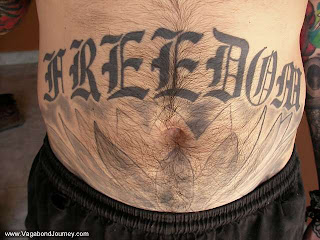
This issue has been in the back of my mind since my first encounters with extreme body modification. Sure, many extreme mods were at first offensive to my eyes and to my logic, but once I got used to the idea that people enjoy cutting and pasting and inking and bedazzling their bodies, it wasn’t so hard to accept. So why can’t lawmakers do so?

Where does the law cease to be about protecting people and start intruding on our personal freedoms?

First, let’s explore the various types of body modification prohibited in the U.S. Specific laws vary from region to region, state to state, and even county to county, but in general prohibitions exist against the following procedures when not performed by a licensed medical professional:
Voluntary amputation, female genital modification (in some places even on consenting adults), subdermal implants, tongue splitting, certain forms of male genital modification, scarification, branding, transdermal implants, uvula piercing, neck piercing, hand/foot/tongue web piercing, eyelid piercing, eyeball tattooing, anal piercing, deep penis/testicle/vagina piercing, skin braiding, “cartilage modification” (presumably that of the ears, a process yielding “elf ears”), saline inflation….anddd probably any other type of mod that some find pleasurable and others find deplorable.

Now to consider why these procedures are seen by our legal systems as so detrimental to individuals and society that performing them must actually be labeled as a criminal offense.
Think first about society’s view of tattoos and piercings up until very recently. In short, they were thought of as barbaric and a sure indication of an unsound mind. This is because, at one time in the history of the Western world, body modifications were found only on criminals and other degenerates of society. When ink and metal leaked out of these lower social spheres and started being seen on the flesh of the general population, negative regard for mods stuck around. Plainskins made no differentiation between modders whose alma mater was the state pen and those who were educated professionals. Their conditioned association between body art and the scum at the bottom of the social food chain couldn’t be undone by a few librarians with tattooed allusions to Chaucer.
The same series of events is unfolding currently as tattooing and piercing are becoming more art forms than trades. Piercing methods have become safer, more sanitary, and more tailored to the human anatomy than ever before. And tattooing has evolved into a fine art where human flesh is the canvas and a tattoo gun the brush. There is a lot of care and pride put into body modification these days, yet inking and adorning the body are still generally looked down upon. This is because the image of a tattooist as a prison scratcher and a piercer as a shady character poking holes in underage kids on the cheap can’t seem to be shaken from the public memory. Although a dying breed, these sorry excuses for mod artists continue to perpetuate a negative social perception of body modification practices and sully the image of the community as a whole.

Society's unwillingness to change their perception of tattooing and piercing despite changes in the circumstances of both parallels societal resistance to accepting extreme body modification. Checkit:

It used to be that S&M amongst gays was the most prevalent arena for extreme body modification. As the gays were viewed as social deviants to begin with, practicing or sporting extreme mods became enough to qualify one for this label as well.

Unsavory history: check.

Female Genital Mutilation/Cutting (FGM/C) is a traditional form of body modification performed on young girls, mainly in Africa, as a rite of passage into womanhood. It is expected by many parents that their female children undergo the procedure, as their marriagability and bride price will suffer greatly as a result of going un-circumcised. When compared to male circumcision in the Western world this may seem all fine and well, until the medical risks of FGM/C are considered. The procedure is done by unqualified practitioners (typically a gypsy) in an unsanitary environment with improper and unsanitary equipment. Infection is common, as is excessive bleeding and problems related to urination and menstruation. The process must be undone just before giving birth (and usually re-done after birthing), and birth-related complications are almost expected for women who have undergone FGM/C. Not to mention the psychological trauma that results…

Existence of poor quality body modification work: check.

Considering the sea of pressing issues lawmakers have to worry about these days, deciding what to do about extreme mods probably doesn’t keep them up at night. Based on what comes to mind when they think of extreme modding, it’s not hard to decide that such procedures should be condemned. All they need is a legitimate reason (aside from social, moral, and religious leanings) to ban the practices, and thus extreme modding becomes categorized as practicing medicine without a license.
OK, fine. You guys have got us there. Despite the amount of research and training that goes into being a proper heavy mod artist, we are doing some admittedly dangerous shit and no, we’re not doctors. But wait…traditional Jewish male circumcision is done by an unlicensed practitioner: a mohel. Non-doctor: check. And it’s religiously and/or socially prescribed rather than a doctor-recommended procedure. Medically unnecessary mod: check. So what’s the difference? If anything, circumcising baby boys is more wrong because it’s done against their will. Consenting adults undergo extreme mods, and under most circumstances they know exactly what they’re getting themselves into, risks and all. And when it comes to voluntary amputation, modding is actually a cure for a medically recognized disorder (BIID). All circumcision does for boys is slightly reduce the risk of urinary tract infections – very slightly. Many argue that it “looks better,” but what about people who think they would look better with a silicone star implanted under their skin? I’m just confused: how is it legal to mutilate a young boy’s genitals for religious/social reasons against his will, but it’s illegal for a sane adult male to opt to have beads implanted under the skin of his penis?
At the end of the day, making extreme mods illegal is not the answer. Not in our country, and not abroad. Even when it comes to FGM/C, education should come before legislation. Some countries in which FGM/C is known to be widely practiced have achieved wonderful results with programs that educate families on the dangers of subjecting their children to this unsafe practice. Simply ceasing the practice of FGM/C is often not an option due to its place in many societies as a traditional rite, but teaching and encouraging more sanitary practices can curb the incidence of complications. Other programs have been successful in working with small communities to actually eradicate the practice altogether by coming up with alternative rites that don’t put young girls at risk. We are headed in the right direction, but many countries have preemptively banned the practice of FGM/C before a means of educating their citizens has been enacted. This results in, at best, a law that people don’t understand and can’t really be enforced, and at worst it triggers the procedure to go even deeper underground and become even more dangerous.
The same applies to extreme mods in the Western world. Education of lawmakers on procedures like voluntary amputation, scarification, and genital beading should be a first step to such procedures gaining legal status. Amputation is the *only* recognized cure for BIID, and scarification and beading (when done by experienced practitioners) are quite safe procedures. In addition, perhaps the world of extreme modding could use a bit of regulation, at least in terms of health inspections in venues where such mods are performed. I support being able to choose what one does to one’s body, but there should be specific sites where these procedures can be carried out as safely as possible and only on individuals of a certain age.
Now, I understand that laws against extreme mods may be in place partially to protect taxpayers from having to support the medical care of individuals who encounter complications with their mods. However, the medical community also handles complications with male circumcision, problems resulting from tattoos and (legal) piercings gone wrong, and conditions associated with the many toxic yet legal substances we ingest every day (i.e. alcohol, cigarettes, trans fats). Plus, making extreme mods illegal only increases the likelihood that modders will end up in the hospital.
Think of it this way - abstinence proved to be an unrealistic answer to curbing unwanted pregnancies and transmission of STDs, so sex education became the avenue of choice. In the same vein, people are not going to stop modifying their bodies. For some people it is a passion, for others a career, and for others, it’s the cure to a tortuous neurological disorder or a means of increasing their self-esteem. Thus, making extreme mods illegal will do nothing but drive it further underground and make it more dangerous than ever. The answer is education and regulation.

Our country can’t be run on conservative values. Just because something is new and shocking doesn’t necessarily mean it should be made illegal, and just because we’ve been doing something for hundreds of years doesn’t make it right. Racism, discrimination against gays, degraded social status of women…we change the stuff that sucks. And ya know what? It sucks that I can’t legally get my tongue split or ear cartilage modified in many areas of the country. Not because I’m worried about the legal repercussions of going for it anyway, but because I want to have access to such procedures in a safe, regulated environment that becomes near impossible to achieve when extreme mods are illegal.
Luckily for the Canadian woman and her team of mod artists, the authorities decided to be lenient and ignore the laws condemning extreme mods – this time. But why? Maybe it was seeing the smiles and laughter and words of comfort exchanged during the procedure that did it. Or maybe they were just too lazy to carry out the dirty work of someone else’s personal vendetta. Or just maybe, they were secretly into heavy mod play themselves. No matter the reason, there’s a woman somewhere in Canada whose satisfaction with her genital mods has grown exponentially as a result of escaping prosecution for acting out a basic desire: to do to her body what feels good.

Tuesday, December 15, 2009

these ain't your grandfather's mods


Our bodies, and the way we see them, are changing. Cochlear implants, LASIK eye surgery, prosthetic everything – medical technology has gradually been getting us accustomed to the idea that the body is something we shouldn’t fear tinkering with. This, in turn, almost certainly has an effect on the way modern society views body modification. In the eyes of some traditional-minded individuals, tattooing and piercing are wrong because they betray the anatomical design granted to us by the Creator. Despite the obvious problems with utilizing this belief as an argument against modding (uhhh, makeup, braces, fake nails…) mothers, grandmothers, and conservative Christians everywhere love to utilize it as a justification for their disdain for mods. Rather than making even the slightest attempt to understand why the kids love modding so, the whole concept is immediately dismissed as wrong by an outdated, closed-minded vision of the human body as a finished product. But this may be changing.
The reasons we acquire body modifications are quite varied, ranging from simple fulfillment of aesthetic predilections to reminding one of a lost family member to rebellion against societal standards of appearance. What remains the same in each case, however, is that the mods provide a vehicle through which to improve our lives. Because the effects of modding are so personal and unique to the mod-bearer, plainskins may have a hard time accepting that mods have any value whatsoever. To them mods are a waste of time, money, and previously pristine skin. But now that modifications of the human body have become a new and exciting area of medical and scientific innovation, that view may be on the way out. Functional body mods have been in the news quite a bit recently, most prominently on gadget blogs like Gizmodo, which is currently featuring a set of articles based around the increasingly cyborgian nature of the modern human. One particularly interesting mod is the newfangled LED tattoo (and another one...), which is actually made up of electrodes that are mounted on silk and embedded underneath the skin. The electrodes have the ability to link up with variety of electronics, allowing for endless possible applications of this wild innovation. Think GPS screens on your wrist, no-fuss blood sugar tests that present results right on your skin, and even a built-in cell phone that appears in LED tattoo form with the simple touch of an inner elbow. Phew. There’s also the man with the bionic sphincter, who wields a remote that allows him to engage and release his sphincter muscle at will with the help of electrodes attached to the sphincter muscle nerves. I can’t imagine how grateful this guy must be for living in a time of such brilliant advancements in the fields of science and medicine.


Now, despite the fact that these new developments in the realm of functional body modification are improving lives, not everyone will agree with them. And if even professionals are still being greeted with skepticism, then surely mod-lovers and the talented practitioners who make their mods possible will continue to catch flack for doing what they love. But we must remember, altering the way an entire society feels about a particular issue doesn’t happen overnight. The slow, agonizing process of change can take decades, even centuries to fully take shape. The good news is that every lil’ bit helps. The increased prevalence of functional body mods is a virtual stepping stone to eventual social acceptance of aesthetic body modification. Not that we neeeed to be accepted - it’s just that, once people become comfortable with an idea, they can finally move past the preconceptions and find their way to a genuine understanding.
I think body modification is fucking fascinating. From pointed ears to pierced ears, whether functional, beautiful, or just plain shocking, mods are important to the owners of the bodies they grace. And that is as good a reason as any reexamine one's opinion of 'em.

Saturday, August 01, 2009

Facial Tattoos: The Last Frontier

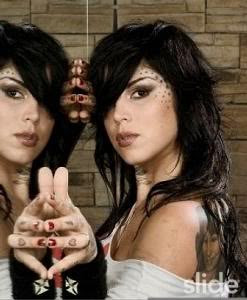
Maybe it's the fact that I live in as laid-back a place as San Francisco, but it seems like even full sleeves don't evoke a second look these days. Tattooing has officially gone mainstream, and the sole alternative survivor is the facial tattoo. It's (no pun intended) an in-your-face mod only undergone by A) individuals employed within the body modification industry, B) people who are honestly positive that they can handle looking in the mirror to see their inked design for as long as their eyes remain properly functioning, and C) idiots. Facial tattoos are a big fucking deal - you gotta think that shit through, moreso than buying a house or getting a dog or even getting married. Shit's serious.No matter the motivation for acquiring facial ink, people with such tats are indiscriminately regarded in most social situations as total freaks. Sure, tattoos are all in good fun at this point in history, but when they're located on one's face they seem to take on new meaning. I happened to catch an episode of Tattoo Highway on A&E recently, and as it turns out two 'stars' of the series sport facial tattoos. The host/main tattooist, Thomas Pendelton, rocks the more controversial mug ink of the two - an upside-down cross just below his right eye. This symbol of rebellion is balanced nicely by an Aum (Om) symbol on his left cheek, but judging from past experiences as a modded individual people probably glaze right over the peaceful piece and focus on what can be interpreted as a demonic or anti-Christian statement. Seeing this bold statement broadcast on national TV made me wonder - are facial tattoos on the way into the mainstream?Kat Von D's may be the very first facial tattoos ever seen by some folks. Although more cosmetic than artistic (if that distinction can be made), her stars would certainly be considered a social faux pas if not for her celebrity status and career of choice to legitimize 'em. But there she is, in the limelight, loved, respected and praised for both her talent and her appearance. Now with Pendelton in the public eye as well, proudly sporting his teardrop-esque tats, I'm wondering if visage graffitied folk of the non-celeb variety will benefit from a gentler reception of their ink by the general public...Well, first off there are a few basic problems to get in the way of this change of heart becoming a reality, the most obvious of which being that not everyone gets A&E and TLC. For those who don't, and have thus been only minimally (if ever) exposed to facial tats, the sight of one in real life would probably evoke utter bewilderment and instinctual disdain. Facial tats bad. Facial tats scary. The same goes for those who do indeed get the channel but would never dream of tuning in to a television program based on an immature, unnecessary practice that betrays the sanctity of the human body. Also, generally speaking, stereotypes and mental associations die hard. Try looking at a swastika and not seeing it glow with evil and hatred. Facial tats are a symbol, and the implication is not good.
Still, there are wholesome families out there gettin' their Art and Entertainment on, gathering 'round the tube to tune in and find out where Pendelton and his crew will venture next or what sappy stories will accompany this week's LA Ink tats. Will the grip of history's disdain for tattoos finally loosen for them, allowing the true beauty of ink to slowly seep into their brains and hearts? I'm hopeful about the potential for a generally positive social perception of tats, but let's face it, they are, for the most part, still only understood by a small majority of this Earth's population. Even a hand tattoo could ensure your long-term unemployment, especially in this hurr recession. It'll probably be quite awhile before facial tattoos are a common feature of the urban landscape, but until then, celebs like Pendelton and Kat Von D can't be hurtin' the odds.
I've always wondered what types of negative reactions those with facial tattoos have actually received from people they encounter in public. One would expect a few mishpas with baby boomers and the like, but what about exchanges with children, or with ignorant mofo's who think facial tats are (as they are in some cultures) meant to be a sign of one's mana, power, status, and try to start trouble with them? How bad does it really get?
Lucky for me, San Francisco is home turf for every variety of alternative/subculturally immersed/weird/creative/unique individuals, so I had no problem finding an inked skull brimming with first-hand 411 on the topic.
Gotta be honest, I talked to this fella probably a month ago so I don't recall his name, but just imagine a dark-dreaded dude, tall and muscular, 30ish, sporting all varieties of leatherwear. Not the type of gear typically accompanied by a chain leash or a ball gag, but rather hand-made brown leather cuffs, goggles, pants...pretty much everything he was wearing was leather. I noticed he and his similarly leather-clad mamacita as they entered the park one afternoon, of course taking immediate notice of his beautiful blackwork facial tats. The couple smiled at me as they passed by, and of course I smiled back, acknowledging my appreciation for their wild appearance. I was doing interviews at the time, migrating from group to group gathering info on people's tattoos, and at one point noticed that they had settled into a shady spot under a palm tree, apparently lacing up some leather stuffs. As I was looking over they noticed me and called me over, probably because I grinned my goofy grin at them upon eye contact. I sat down and they were immediately welcoming, telling me all about their leather goods and their "gypsy" lifestyle. I was pretty blunt with the dude, telling him that I'd never met anyone with facial tats before and that I really loved his. They conformed to the anatomy of his face, beautiful curves and swirls everywhere. Definitely some well-done tats. He was super cool about answering all my questions, perhaps because he had never been openly asked about them. I'd think that most people would avoid acknowledging them altogether. Although plainskins can often be heard asking tatted folk "Oh golly, did that hurt?!", I bet they don't make any small talk with this dude. In any case, one interesting thing leatherman told me is that when he looks in the mirror his face just looks "right," and that he doesn't even pay notice to the ink anymore. "If I'm looking in the mirror it's usually to see if I have somethin' in my teeth or on my face, ya know?" Most facially pierced peeps and their loved ones can probably identify with this phenomenon - after awhile the metal just becomes another feature of your everyday appearance!
I felt a bit awkward asking him the next question, but I'm not quite sure why. I wanted to know if it was common for him to get shocked reactions from people he encounters on the streeet. Maybe I didn't wanna imply that he looked like a freak - which, I mean, I think he looks great but if I took him home to Connecticut to meet my mom she would absolutely flip her shit. Dude was, of course, totally cool about answering - he basically said that he doesn't get too many crazy reactions, but that he doesn't pay much attention to what other people think so perhaps he just fails to notice the elderly women fainting all around him as he walks the city streets. Makes sense, I mean, if you're gonna go so far with satisfying your desire for a strikingly unique appearance as to have it permanently cemented into your flesh, you better have some thick skin (too easy...) to go with it. I really respect that. Not giving a fuck is, ironically, a mindstate that takes a strong mind to attain.
We hung out for a bit longer, but after my initial inquiries I chilled out with the drillage. I was content just enjoying the couple's company, and although the opportunity was ripe for me to really deconstruct what it's like to have facial tattoos, it was nice to just chill and chat. I haven't seen the dude since, but perhaps he'll drift my way again sometime and I can do a more in-depth follow-up. Until then I'm interested to see what new arenas tattooing will enter now that it's taken residency in the mainstream. It's already found its way into clothing, cosmetics, and, thanks to Ed "Sellout" Hardy, it's now in the water. Sickeningly trendy, yes, but the appearance of tattoos in so many facets of modern life surely serves to indirectly improve the face value of those with a tatted face. So, reluctant as I may be to accept shit like this...I guess I'll cosign. Ugh I just threw up in my mouth a little....

secondary source for my own work!

Hey y'allllllz
So, I've been cheating on you a little...
San Francisco has brought me unimaginably beautiful experiences and opportunities, one of which being an internship with Upper Playground. I've been writing for their web publication, the Citrus Report, and my newest piece is an interview with one of my very favorite modern tattoo artists, Jesse Smith!

Checkkit out here!

New MSOM-specific content soon, swearsies!
<3

Thursday, June 11, 2009

reading between the line tats

So it's no newsflash that hipsters from Williamsburg to Seattle love them some tattoos. Bicycles, Twinkies, leather chairs...those kids will tattoo just about anything on them so long as it's obscure - just like their taste in music, film, and breakfast cereal - "Ever had Kaiji-hin O's? Shit's from Japan and has a hint of seaweed in every bite! Can't believe you've never heard of it..."
Anyways, since moving to San Fran I've seen my fair share of hipster tattoos, and have noticed a few trends despite all the diversity. One such trend is particularly intriguing: hipsters seem to love both a) ultra-detailed, super-saturated, photo-realistic tattoos, and b) on the extreme other end of the aesthetic spectrum, simple, plain, unembellished linework tattoos. You won't typically find both styles adorning the same individual, suggesting that these styles really reflect one's enduring aesthetic predilections. They damn well better - that full color rainforest sleeve is gonna be with you for a longggg time...
I'm personally a big fan of the more realistic breed of tattoos, as evinced by the spontaneous drooling that occurs when I visit the web galleries of such tattooists as Jesse Smith, Mike DeVries, and Jason Jacenko. But friends of mine are in love with those mysterious line tattoos...either simple geometric shapes or childlike drawings of flowers, hearts, birds....you've seen these, right? I first encountered this style of tattooing a few years ago upon visiting the webpage of Yann, a French tattooist with a truly distinctive artistic style. His tats resemble Kindergarten scribbles, but contain subtle details that unfailingly evoke a smile at the sheer silliness of it all. I can totally see the appeal of Yann's delightfully sketchy tats, but what about a tattoo like the plain square outline sported by a model in a Marc Jacobs ad (searched and searched but couldn't find an image!)? What the fuck, dude? Is it a commentary on how we've gotta start thinking outside the box about ways to fight global warming? Is it a d/l tribute to your beloved Macbook Pro? Is it just teeming with esoteric information about your inner self? Whether truly acquired for reasons existential or superficial, a tattoo like that can hold any number of meanings depending on who's asking. And surely people ask - with most tattoos one can simply infer the significance at least to some extent, but line tats beg to be inquired about.
I had always been curious about these inked anomalies, but never thought to question people with line tattoos about the significance of their designs or their affinity for a super-simple tattoo style...that is until now. Recently I spent a sunny afternoon in Dolores park unabashedly lowering my shades and inspecting every tattooed body in sight, and sure enough I found quite a few that were rendered in the style in question. As modders always are, the owners of these understated works of ink were happy to divulge some details about their affinity for simplicity.
My first interview was with a guy who goes by the name of Dante. His arms boast a total of three filled-in black rectangles, and spanning his back is a simple outline tattoo that resembles a pair of sword/wings. According to Dante, his rectangles were inspired by elemental tattoos he's seen, and represent "the void" as a simple element (however you wanna interpret that...). Now 26, he got the first of his rectangles when he was 18, acquiring the second set when he was 20. As for the locations, Dante gave an all too familiar explanation as to why he chose the spots he did for his rectangles - "Sometimes you just kinda know where you need the tattoo." He's an artist himself, and says he likes to "make art create itself," which has predisposed him to shun photo-realism in favor of abstraction. Over the course of our conversation he revealed increasingly cryptic ways of understanding his rectangle tattoos, explaining at one point with a slightly sinister growl that he sometimes sees them as "windows with only black on the other side." Dante believes that although not everyone's do, tattoos "should" have meaning to the wearer, and because of the symbolic nature of his tats that meaning doesn't have to be completely one-dimensional or remain consistent over time. Oddly enough, despite the "abstract personal significance" that Dante's tattoos have for him, one artist he approached refused to ink his second set of rectangles because he basically thought they were a waste of a tattoo. Fucking hardly - it was obvious from talking with Dante that he absolutely adores his tat, regardless of how anyone else sees or interprets them.
Next up was Peter, whose stunning red and black line tattoo caught my eye from across the park. "Damn, that looks like a Yann..." I thought to myself as I headed off in his direction, "...but it couldn't be, probably just some rip-off of his style..." But to my surprise, Peter's half sleeve was indeed inked by the fabulous Frenchy himself, and is a shining example of the incredible things dude can do with a few lines. The tattoo is Yann's interpretation of a portion of Picasso's "Guernica," and depicts a disembodied arm holding a broken sword that has a flower growing out of it. Peter explained that Picasso's original message in "Guernica" was an anti-aggression, anti-war statement that is still relevant today, and although not many people will recognize the tat as a political statement Peter is still proud to sport it.
In addition to being a reflection of Peter's political beliefs, his tat is also a reflection of his overall aesthetic affinities - "Generally I like simple aesthetics, just really minimalist-type stuff that still holds some power. I like that in all arts, music even and movies." Throughout our chat session Peter kept emphasizing that although simplicity may seem to imply a lack of depth, many works of art are strikingly powerful in their simplicity. He also mentioned, and I really appreciate his frankness in admitting this, that his attraction to simple tattoos is in part a reaction against the opposite trend in tattooing of acquiring painstakingly detailed pieces. This admission called to mind how in the 60s and 70s minimalism developed in opposition to abstract expressionism, adopting a "less is more" mentality. Peter also sports a Yann-inspired flower that was inked by a friend of his years before his genuine Yann piece, and though not so impressive as the "Guernica" tribute, is still a smile-inducing treat. Despite the fact that Yann is currently stationed in Montreal and currently has no plans of doing guest spots in the States, Peter says any future ink ventures of his will be conducted exclusively by Yann. Peter, please, for the sake of everyone with fully functioning vision, stay true to this promise and keep going back for more beautifully unique pieces of inked simplicity!
My next interview was quite impromptu, and actually occurred after I had left the park. I had stopped into a Whole Foods Market, and while getting rung up for some overpriced bread and cheese happened to notice that the cashier was sporting a very simple, black outline tattoo. In response to being asked why she chose a more basic tattoo style, she thought for a moment, then said "well, they're simple, but they're not." Simply stated, but her response conveys an oft-expressed sentiment amongst line tat canvases. Relating her love of simple tattoos with her affinity for simplicity in general, and referring specifically to children's movies, she said "It doesn't need to be this crazy CGI bullshit." She prefers 2-D comic book art, as well as the illustrations of both Tim Burton and Edward Gorey. Although relatively understated, both artists' work is quite dark and emotive despite its simplicity. She said it best..."they're simple, but they're not." Since she was working we didn't speak for long, but I really liked the way she struggled to explain her ineffable love for the unremarkably remarkable.
The next brain I picked was that of my good friend, Dor. The first words I ever spoke to him were about the line tattoos he sports on his left arm, which I obviously noticed as soon as he walked into the room. I was intrigued by the designs, and especially in my then-inebriated state couldn't help questioning him about them. One tat is a thin black line that begins just above the elbow and extends upward, culminating at his shoulderblade in a series of freehand curls meant to represent loose guitar strings and thus his love of music. The only other embellishment is a small, filled-in half circle that rests along the line at around its midpoint. The other tat begins with a tiny heart on his thumb that's connected to a single black line running the length of his forearm, accented by a treble-clef-ish swirl design just above the wrist. Dor drew both tats himself, and both were done by the same artist in his homeland of Israel. The first tattoo was originally going to be only one line, but while chatting with his tattoo artist after the line was completed both agreed that it needed a little something extra. After throwing out a few ideas they decided that the half circle and curls would work well, and went to it. Since both tats are uber-simple, I pressed Dor to try and analyze why exactly he's so attracted to minimalist tattoos. "I wanted something which is not gonna be something," Dor explained, continuing, "I don't want to be a sketchbook, I want to feel like the tattooist is putting art on me. [Tattoos] can be interesting, not just pictures of stuff you know." This got me thinking about the super-slippery meaning of the word "art." Take graffiti for example - what to one person is a breathtaking artistic wonder is to another an eyesore. Or cubism, which to some is a complex artistic style that truly engages the viewer, and to others isn't worth more than a hands-clasped-behind-your-back-pause-for-a-hot-second-then-continue treatment at the museum. For Dor, art is abstract, intangible, and plurally interpretable. It means whatever the fuck you want it to mean, as long it makes you happy when you look at it.
Contrary to Dor's conception of his tats, one park-dweller named Ben seemed to see his simple ink as not works of art but symbols. One of his tats is a dumbed-down version of the D.C. flag, another is a black linework rendition of the Hand of Fatima, a symbol used throughout history in both the Muslim and Jewish religious traditions, and the last is a set of elongated black rectangles meant to represent the twin towers, the attack upon which occurred while Ben was attending NYU. Each one represents a geographical location that holds significance for Ben, and he doesn't intend on straying from this format anytime soon. His next tattoo will be of the California coastline, minus all other details that might identify the squiggly line as a reference to his current state of residence. "I've got my style I guess," Ben said with a shrug. What's odd is that he claims to love full color sleeves on other people, but feels like he's "too boring" and "not creative enough" to come up with the concept for one of his own. Instead he acquires ink that's visually simple yet holds complex meaning.
So, I guess the main thing I've learned from talking to all these sketchbook kids is that you really can't judge a tat by its intricacy. A few black lines may indeed have more meaning and can indeed be more beautiful to some eyes than a photo-realistic tatted flower garden. You never know until you ask, and I for one am really happy I finally did. When I used to look at simple tats I would hear them scream, "Look at me, I'm different! I'm weird! I'm obscure! You totally wanna meet my owner..." - but I wasn't reading between the lines. And when it comes to simple tattoos, that's where the true message lies.

Wednesday, May 13, 2009

the rules have changed

Well, here I am! After living out of a suitcase for three weeks, sleeping on couches and craigslisting my ass off, I can finally say that I'm a resident of San Francisco! I made it! And all my stuff finally did too - posters, photos, and everything else that makes me feel at home arrived just a few days ago in travel-worn cardboard boxes. Yay!
I'm still getting settled in here, learning the bus lines, trying to have a good time without going broke, all while waitressing about 6 days a week. But just as I expected, even with things as chaotic as they are, I've found plenty of time to write since I got here. Everything around me teems with wild and unique beauty, delighting my eyes and inspiring new ideas around every turn. I currently have one investigative piece in the works, but for now I'd like to address an issue that has likely hit home for every modified Albert and Christina out there. How do you have to un-modify your body to accommodate your workplace's dress code? Most of my managers in the past have been totally accepting of my mods, but my most recent job at Chili's in CT had a much stricter, corporation-dictated dress code that left no room for metal or ink of any kind on the dining room floor. For this reason, I wasn't sure what to expect at the new restaurant I'm working at in San Bruno. Would they be ok with my ever-changing candy-colored coif? My 3/4" plugs? The clear vertical labret retainer I usually wear to work? The calla lilies on my arm that peek out from short-sleeved shirts?
Before my first day of work I had to go in for a number of (stupid) evaluations which, supposedly, determine if I have the right stuff to be a server. After completing an SAT-reminiscent exam that evaluated my mathematic and linguistic ability, and a personality exam to ensure that I'm not a psychopath, I was subjected to a test in which a manager read off hypothetical restaurant situations and I had to respond with potential ways to handle them. Thankfully I passed all of the tests, and was handed a schedule with my name filled in for four shifts that week. Whoo, money!! Before I left, the manager gave a me a little rundown of the rules, including dress code. "I'm supposed to tell you that tattoos can't be showing," he told me with a grin, obviously implying that they have better things to worry about, like good service and happy customers, than some harmless ink. I scanned the restaurant and noticed a tattoo on one server's elbow, and another girl whose rolled up long sleeves revealed full tat sleeves. Things were looking good.
My first day of work came, and actually went pretty smoothly. The customers tipped well, I didn't mess up any orders, and the other servers were all pretty cool. In fact, nearly all of them wore some variety of facial piercing, from monroes to labrets to eyebrows. I began asking the servers about the piercing policy, and nearly all of them referred me to a poster in the office that laid out the (arbitrary) rules for "what's hot" and "what's not" when it comes to mods in the workplace. Here are a few shots of the poster that I stealthily snagged with my phone:
I have to say, I was pleasantly surprised by the guidelines. The "no piercing over 16 gauge" rule ensured that I wouldn't have to wear that stupid retainer in my vertical labret anymore! Also, the wearing of band-aids over piercings, an unsightly practice required by many CT food service employers, is openly discouraged by the poster. I never understood the band-aid solution - a piercing is a piercing but a lump under a band-aid could be anything! It's distracting, unsanitary, and terrible for the piercing, especially if it’s relatively new.
According to my new manager the poster had been distributed not more than a year ago. So although a bit late, I commend Chili's for actually getting with the times and realizing that piercings and tattoos are incredibly common these days and that they don't carry the same connotations they have in the past. Well, apparently some still do, such as the septum piercing, which is specifically forbidden by the poster. However, although both full sleeves and large gauge ear piercings are supposedly "not hot,” they seem to be accepted without question in practice. This made me wonder, will updated guidelines continue to be released to keep up with changing trends and levels of social acceptability? Will the surface anti-eyebrow featured in one of the poster photos soon become the new hot accessory, merely a conversation piece rather than an extreme, shocking facial adornment? Who can tell…an amalgamation of media images, cultural norms dictated by peers, and personal experience combine to form our perceptions of what is socially acceptable in any given situation. Although we can all agree on what is appropriate in some situations, others will always be grounds for disagreement. Thus guidelines like those laid out in the poster will always be only one version of what's considered "acceptable" or "mainstream" in the realm of body mods.
For now, I’m more than happy with the minimal adjustments I have to make before going into work. I actually agree with the corporate opinion that my septum piercing should be hidden, and even when I was allowed to look however I wanted at my old cafĂ© job I didn’t wear it out. I don’t even notice it on myself anymore, but I realize that it is a bit distracting for other people, especially older folks.
San Francisco is such a wonderful environment to live in - every single day I see people on the street grinning like children, dressed like children, stumbling along like children. No one cares if you have a chocolate ice cream stain on your shirt or ropelike dreads for hair or a face full of tattoos - everyone is accepted here for who they are and what they choose to look like. Of course this place isn't some fantasyland utopia where everyone gets along, but it's pretty damn close. And I feel absolutely blessed that I'm getting the opportunity to be a part of it.