We as humans have created a complex relationship between objects and concepts. Michael Foucault was a French philosopher who wrote a number of works addressing this relationship. In his "The Archaeology of Knowledge," Foucault points out that meaning is not inherent, but that it is projected onto things through experience and becomes somewhat fixed over time. When put into the context of body modification, this object/meaning concept seems to be the basis of discrimination against modified persons. Tattoos and piercings have acquired a negative association by the experience of people who, in the past, observed modifications only on bikers and members of various other marginal subcultures. Regardless of the ever-increasing diversity of the western modified crowd and a distinct shift in the use of body modification by this crowd, such associations remain unchanged.
So, if we as modified persons are still receiving negative attitudes toward our mods when we have personally done nothing to justify such reactions, what are we to do? How can we change the meaning of modification? How can we modify modification?
This subject has been of considerable interest to me since I started getting seriously involved in body modification. In fact, it has changed the way I think about my life and interactions with others. When speaking with unmodified folk, I often wonder what they think of my various adornments. Are they shocked? Intrigued? (perhaps my next project will be to find out what they really are thinking...) With these uncertainties came a desire to project a positive image onto modification. In other words, I want to soften unmodified persons' experiences of modification in an effort to change the meaning behind modification itself. I realize that the national impact of my efforts will be nearly non-existent (for now), but if I act as the young, intelligent, psychologically stable poster-child for body modification, maybe I can alter a few unjustly negative impressions of modification along the way.
Now, I know that in past posts I've stated that we as a modification community shouldn't have to legitimize our practices. That's why I want to stress that the reasons behind my efforts to soften modification are more intellectually based than modification-based. It intrigues me that we make what seem to be natural connections every day, and yet many of those assumed associations aren't truly inherent. Meaning is fluid. We develop meaning based on experience, and over time meaning continues to exist, even without justifying experiences. This is the concept I've been trying to explain to my parents to make them realize that their detestation of my mods is unjust. And this is the concept that is behind much of the discrimination that goes on in our society.
Monday, March 20, 2006


Monday, March 13, 2006
Skydiving anyone?
'Pierce' is a term that's often found in news reports about gun battles, stabbing incidents, and other types of unwelcomed invasions of one's body by another individual. So how is it that the same term is used to describe the ancient and modern day practice that many people regard as beautiful, expressive, and even empowering? I think that although being attacked and physically violated is very conceptually different from adorning one's body, both experiences share some common ground. How can this be? Well, ask any survivor of a stabbing, animal attack, or extreme sports injury if there has been any positive consequences of their ordeal, and you will find the answer.
 For the very reason that the idea of being attacked is frightening, it is also empowering. Those who survive a traumatic experience often emerge from the initial shock of their experience with a sense of pride and hope at the thought that they have just 'survived' one of life's most difficult events. Once one has gone through the worst of what life has to offer and survived, there is often an overwhelming sense that any other difficulty that comes one's way will be easily conquered.
Now to apply these sentiments to body piercing. When looked at it in comparison to attacks upon the body, body piercing is merely a controlled version of such. The adrenaline rush of being attacked is present in piercing, but it is accompanied by excitement rather than fear. Also, there is the same sense of pride and hope when a piercing is finally complete. Just as the wounded show off their 'battle scars,' piercees proudly display their marks. And just as attackees are often given hope by their experiences, piercees may come upon a new sense of power over their bodies, indicating that one does have control over one's own life, and can overcome any obstacle encountered.
So just maybe one of the reasons we become pierced is to experience what would normally be a terrifying experience, but in a more controlled fashion. In this way, we reap the benefits of a traumatic event minus the trauma that often accompanies it. I don't know, just an idea. It seems to hold true with myself as a piercee, but that's just me. I'd be very interested to find out if the same is true for my readers. (Hint hint comment comment :o) )
 For the very reason that the idea of being attacked is frightening, it is also empowering. Those who survive a traumatic experience often emerge from the initial shock of their experience with a sense of pride and hope at the thought that they have just 'survived' one of life's most difficult events. Once one has gone through the worst of what life has to offer and survived, there is often an overwhelming sense that any other difficulty that comes one's way will be easily conquered.
Now to apply these sentiments to body piercing. When looked at it in comparison to attacks upon the body, body piercing is merely a controlled version of such. The adrenaline rush of being attacked is present in piercing, but it is accompanied by excitement rather than fear. Also, there is the same sense of pride and hope when a piercing is finally complete. Just as the wounded show off their 'battle scars,' piercees proudly display their marks. And just as attackees are often given hope by their experiences, piercees may come upon a new sense of power over their bodies, indicating that one does have control over one's own life, and can overcome any obstacle encountered.

So just maybe one of the reasons we become pierced is to experience what would normally be a terrifying experience, but in a more controlled fashion. In this way, we reap the benefits of a traumatic event minus the trauma that often accompanies it. I don't know, just an idea. It seems to hold true with myself as a piercee, but that's just me. I'd be very interested to find out if the same is true for my readers. (Hint hint comment comment :o) )
Saturday, March 11, 2006
Out of body experience
I've recently been prompted to discover what it is about body modifcation that appeals to me. I have already established that mods are important to me for a number of commonly heard reasons, but now it's time to ask myself (and perhaps time to ask the same of yourselves?) what it is about my personality and experience that has contributed to my love of body modifcation. The road to discovering the truth about my passion seems a bit unnerving, but there are a few shortcuts along the way which I will discuss in the next few posts. Hope you enjoy, and perhaps ask yourselves some of the same questions I will be asking myself. Who knows, you might find out something about yourself, even if you aren't modified.
I have recently realized that in becoming conscious of my mods I become aware that I have a body. One who is modified is much better equipped to experience varying degrees of consciousness on demand. In having one's body poked and tended to, one becomes very aware that the body is something that we have control over and can change as desired. I think that this quality of modification is part of the reason why every mod process is/can be a spiritual experience. Every new mod is another way to transcend the barrier between the everyday sense of being a body and the occasional sense of having a body that you are in control of. Do you see? Ponder that a bit, and try to recognize how incredible the concept of body modification is. Who picked up a sharp stick one day and said "Hey, I think I'll shove this through my earlobe." Well, no one, because that definitely wasn't the vernacular of the time, but you get the idea.
I have recently realized that in becoming conscious of my mods I become aware that I have a body. One who is modified is much better equipped to experience varying degrees of consciousness on demand. In having one's body poked and tended to, one becomes very aware that the body is something that we have control over and can change as desired.
 I think that this quality of modification is part of the reason why every mod process is/can be a spiritual experience. Every new mod is another way to transcend the barrier between the everyday sense of being a body and the occasional sense of having a body that you are in control of. Do you see? Ponder that a bit, and try to recognize how incredible the concept of body modification is. Who picked up a sharp stick one day and said "Hey, I think I'll shove this through my earlobe." Well, no one, because that definitely wasn't the vernacular of the time, but you get the idea.
Tuesday, March 07, 2006
belief or bull?

Body piercing has been performed for centuries with many recorded meanings to accompany the practice at each location and stage of its use. The most common response one gets to the question of why body piercing is performed in contemporary western society is that it is a vehicle for the expression of one’s individuality, or that the piercing is aesthetically pleasing to the wearer. Past justifications for the use of piercings and other body modifications in a variety of cultures have been class/status-related, fashion-related, or had to do with the supposed spiritual power that some forms of modification are believed to possess. I have recently become inadvertently interested in the latter purpose through some research on the concept of using piercing and scarification as way of boosting the immune system.
The majority of information that I found regarding piercing and health was closely related to acupuncture. It was on a suspicious website that I first encountered the concept of energy meridians, and how some people believe that body piercing and tattooing disrupts these meridians, leading to a variety of unfavorable consequences. I don’t quite trust the original source, as other articles from the main site were extreme and some seemed strongly biased, so I continued my search. The next site I came upon that addressed the energy meridian issue was a collection of articles and reports compiled by some guy with a Ph.D. Good enough for me! His research seems to suggest that energy meridians do indeed exist, but even if this is true, I still couldn't find any proof that body piercings would prevent these pathways from operating properly.
After a bit more research on energy and body piercing, I found that many modern suspension rituals are connected to energy flow within the body. I also found some information that challeneges the claim that piercing disrupts enery meridians. Reputable One Tribe’s website responds to this issue with the following example: “if you cut your leg off and it's sewn back on the meridians still work because the body realizes it’s a wound and re-routes the energy accordingly. A piercing is a wound and therefore it doesn't affect the flow of energy.”
As a result of the many varying attitudes I observed, I get the feeling that I will not uncover the truth about bodily energy as it relates to body modification by any means short of intensive research and experimentation in the subject. At least the information currently available gives me a new and interesting perspective on the art of body modification, and furthers my awareness of its dual simplicity and complexity. Ah, modification - it's such a beautiful thing :o)
Thursday, March 02, 2006
more thaipusam madness
Last night I just couldn't get to sleep, so rather than watching one of 4 channels that comes in on my dorm room TV, I headed up to the library. There I took out a movie entitled "Floating in the Air, Followed by the Wind," a film that one of my professors had recommended. It's an informative documentary on the Thaipusam festival in Kuala Lumpur that I discussed in an earlier post, and I was eager to check it out.
Although I had already read loads of articles and explored a plethora of pictures from Thaipusam, not until I saw this film did I feel that I had a full understanding of the extent to which the festival holds importance for its devotees. The director interviewed a number of devotees and tracked their preparation for and participation in the festival. The resulting documentary reveals the real-life reasons that many Hindus take part in Thaipusam, and how their acts of worship are related to the Hindu belief system. There is also a focus on the deep trances that are induced before a participant receives any piercings or kavadis, and how this technique must be learned and practiced long before the festival begins.
 Man bearing a kavadi at Thaipusam
From the moment I popped the tape into the VCR (yesss it's old) all the way until the film ended, there was an enchanting melody playing in the background. This tune set the mood for the rest of the film, giving it a trance-like feel which contributed to my finally being able to understand the missing piece of Thaipusam that I couldn't have attained through pictures or written descriptions of the festival. I now see that the deeply spiritual nature of the festival gives it an almost supernatural air, which is added to by the melange of metal mouthguards held in place by pieced cheeks, and 60 pound kavadis on the backs of 65 year old men.
Mouthguard supported by dual cheek piercings at Thaipusam
Although this film was a bit outdated, it was quite effective in conveying the shockingly different cultural behaviors of some non-Western societies. Many Westerners might be disturbed upon seeing a film like "Floating in the Air, Followed by the Wind," but why? Well if there was a screening of Doctor 90210 or The Swan at Thaipusam next year, I think that the reaction would be quite comparable. Ahhh, cultural differences.
Although I had already read loads of articles and explored a plethora of pictures from Thaipusam, not until I saw this film did I feel that I had a full understanding of the extent to which the festival holds importance for its devotees. The director interviewed a number of devotees and tracked their preparation for and participation in the festival. The resulting documentary reveals the real-life reasons that many Hindus take part in Thaipusam, and how their acts of worship are related to the Hindu belief system. There is also a focus on the deep trances that are induced before a participant receives any piercings or kavadis, and how this technique must be learned and practiced long before the festival begins.
Man bearing a kavadi at ThaipusamFrom the moment I popped the tape into the VCR (yesss it's old) all the way until the film ended, there was an enchanting melody playing in the background. This tune set the mood for the rest of the film, giving it a trance-like feel which contributed to my finally being able to understand the missing piece of Thaipusam that I couldn't have attained through pictures or written descriptions of the festival. I now see that the deeply spiritual nature of the festival gives it an almost supernatural air, which is added to by the melange of metal mouthguards held in place by pieced cheeks, and 60 pound kavadis on the backs of 65 year old men.

Mouthguard supported by dual cheek piercings at Thaipusam
Although this film was a bit outdated, it was quite effective in conveying the shockingly different cultural behaviors of some non-Western societies. Many Westerners might be disturbed upon seeing a film like "Floating in the Air, Followed by the Wind," but why? Well if there was a screening of Doctor 90210 or The Swan at Thaipusam next year, I think that the reaction would be quite comparable. Ahhh, cultural differences.
Tuesday, February 28, 2006
crossing my fingers...
So this past weekend I came into my hometown tattoo shop to get my quarter sleeve worked on a bit. Over the course of the hour or so that I was there, my artist Chriss and I caught up on everything that had happened since my last time in the shop. As usual, my independent study course on body modification came up, and I eagerly told Chriss that I was planning to apply for a number of scholarships that would allow for me to do independent research this summer in a foreign country. I asked if he had any advice as to where I should go if I want to study a dying form of culturally significant body modification, and he mentioned that the Maoris of New Zealand would be an excellent peoples to look into. Upon talking about this prospect some more, I began to get really excited about the idea of studying the Marois, and so did Chriss. So much so, in fact, that he offered to come with me if I get a scholarship! I became further enthused when he reminded me that we could get traditional Maori tattoos if we go. Need I more motivation to kick this applications ass?
 Traditional Maori facial tattoo
Just when I thought I couldn't be more pumped about the idea of heading to beautiful New Zealand to study body mods, I found this story on BME's Modblog. Please please please check it out, it's an amazing story. It's basically about a girl named Olivia who is only slightly older than myself and is currently in Tanzania studying the Maasai peoples. Olivia's own blog page recounts every last detail of her amazing journey. Reading about her experience made me want to steal my tattooist away from his shop and hop a plane to New Zealand immediately. But I restrained myself...
So, wish me luck with my applications; I'll be needing it. Hopefully my school recognizes that this experience may be the single most fascinating thing I have ever done and decides to fund it. Sure, if I don't go I can still spend my summer working and getting modified, but if I do end up going I will gain more than some ink and metal under my skin - I will have had the opportunity to be a part of one of the few remaining cultures who still modify as their ancestors did. I cannot even describe how much that would mean to me.
Traditional Maori facial tattooJust when I thought I couldn't be more pumped about the idea of heading to beautiful New Zealand to study body mods, I found this story on BME's Modblog. Please please please check it out, it's an amazing story. It's basically about a girl named Olivia who is only slightly older than myself and is currently in Tanzania studying the Maasai peoples. Olivia's own blog page recounts every last detail of her amazing journey. Reading about her experience made me want to steal my tattooist away from his shop and hop a plane to New Zealand immediately. But I restrained myself...
So, wish me luck with my applications; I'll be needing it. Hopefully my school recognizes that this experience may be the single most fascinating thing I have ever done and decides to fund it. Sure, if I don't go I can still spend my summer working and getting modified, but if I do end up going I will gain more than some ink and metal under my skin - I will have had the opportunity to be a part of one of the few remaining cultures who still modify as their ancestors did. I cannot even describe how much that would mean to me.
Saturday, February 25, 2006
modified pinups and empty eye sockets make lovely tattoos
In my search for a new tattoo, I've come across some amazing art that I'd love to share. First off is an artist named Alayna Magnan who specializes in modern pinup drawings. Some of the figures she draws are pierced and tattooed, but all of them have distinct characters that come through in the detail of Alayna's work.

Also of particular interest to me was the art of Luke Chueh. Shannon Larratt from BMEzine.com recently posted a picture of a tattoo depicting Chueh's art, showing that his pieces work well when transformed into trippy tattoos. His art is great because it combines such intangible concepts as enlightenment and despair with cute, furry, bloody animals to create a humorous yet meaningful style.
Finally I'd like to mention the ever-psychadelic art of Thomas Han. Han has worked with Luke Chueh on a few pieces (one of which is shown below) to create some incredibly fun-to-look-at work. Upon first seeing Han's work, I fell in love with the color scheme he uses. I think many of his pieces, adapted to tattoo form, would be quite the eye-catchers.

These artists are young and revolutionary. I can only hope artists like these become immortalized through tattoos of their work. After all, there are so many Tazmanian Devil tattoos out there, it makes my head spin. Let's get original.
Sunday, February 19, 2006
tattoos: art vs. fad
In considering my next tattoo, I have been giving a lot of thought to the idea of tattoos in general. When looking at artist portfolios, I can usually tell after viewing only a few pictures if I am interested in the artist's work or not. I never gave this process much thought until I read Needled.com's recent post about tattoo studio-art gallery hybrids. Seeing tattoos as a form of fine art, displayed in a gallery where everyone from punks to executives can view them, made me realize that what I have been seeking in my search for a new tattoo is a piece of ART. Looking at certain artistic pieces makes me all warm and fuzzy inside, and to have one of those pieces permanently affixed on my skin would be a constant source of joy and wonder for me.
The article also made me think about the gallery in relation to its possible effects on how tattoos are viewed in Western society. Many Westerners still associate tattoos with crime and social deviance, so it's natural to wonder whether such mainstream recognition of tattoo art would help to bring it a greater level of respect. Personally, I think that those involved in the body modification community shouldn't have to work toward legitimizing modification in the mainstream. If the majority of people can't see the beauty of modification, why should we try to convince them? As a student at a very small college with a lot of conservative-looking kids, I can say that I truly don't care if I'm seen as different or weird, because I understand it. This is for ME. And I think that celebrating tattoos as fine art is a wonderful step, but not toward acceptance. It is my hope that this will be a step toward making body modification the best it can be.
I understand that my own view of the future of body modification is just that, MY view. With that said, I need to address those random images of butterflies or roses littered about some "tattooed" bodies. These do not represent art. Don't get me wrong, such tattoos may have value in their personal significances, but they are not acquired for their aesthetic beauty. Most are just a fad, and the concept of having a tattoo is probably more important to the wearer than the tattoo itself. I mean, think of the bold tribal desgins you often see flashed from under the back of a woman's low-cut tee shirt. Does she have any clue what that symbol may have meant to some ancient peoples? And would she even have noticed if the artist didn't apply the exact design she had picked out?
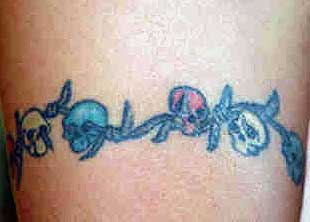
A great example of this disregard for the art of tattooing is a conversation I had this past weekend at a professional wrestling show. There I met woman and her boyfriend who unfortunately both had some of the most terrible tattoos I have ever seen. The man proudly showed off a cat/woman pinup on his calf which had incredibly shaky and far too-thick lines. In addition to the form of the tattoo, the content was also quite unpleasant. The pinup's breats were saggier than those of a retired stripper, and her nipples were the size of teacup saucers. As for the woman, she only had one small, obviously home-made, black heart on her upper arm. Upon asking her about the tat, I received a lengthy response in which she explained to me the tattoos that she was planning on getting. These included a spider web on her upper arm (which I explained to her is often associated with a certain white supremacy group...oops good thing we talked), a "Jesus-style crown of thorns, because barbed wire is sooo overdone," a rose, and a Blood for Blood (a Boston Hardcore Band) skull design. All status symbols. Not the kind that will get you into a country club, but rather the kind that will (maybe) earn you a greater level of respect. Imagine one of her future tats in a gallery as a painting. Would anyone "ooh" or "ahh?" I think not.
The article also made me think about the gallery in relation to its possible effects on how tattoos are viewed in Western society. Many Westerners still associate tattoos with crime and social deviance, so it's natural to wonder whether such mainstream recognition of tattoo art would help to bring it a greater level of respect. Personally, I think that those involved in the body modification community shouldn't have to work toward legitimizing modification in the mainstream. If the majority of people can't see the beauty of modification, why should we try to convince them? As a student at a very small college with a lot of conservative-looking kids, I can say that I truly don't care if I'm seen as different or weird, because I understand it. This is for ME. And I think that celebrating tattoos as fine art is a wonderful step, but not toward acceptance. It is my hope that this will be a step toward making body modification the best it can be.
I understand that my own view of the future of body modification is just that, MY view. With that said, I need to address those random images of butterflies or roses littered about some "tattooed" bodies. These do not represent art. Don't get me wrong, such tattoos may have value in their personal significances, but they are not acquired for their aesthetic beauty. Most are just a fad, and the concept of having a tattoo is probably more important to the wearer than the tattoo itself. I mean, think of the bold tribal desgins you often see flashed from under the back of a woman's low-cut tee shirt. Does she have any clue what that symbol may have meant to some ancient peoples? And would she even have noticed if the artist didn't apply the exact design she had picked out?

A great example of this disregard for the art of tattooing is a conversation I had this past weekend at a professional wrestling show. There I met woman and her boyfriend who unfortunately both had some of the most terrible tattoos I have ever seen. The man proudly showed off a cat/woman pinup on his calf which had incredibly shaky and far too-thick lines. In addition to the form of the tattoo, the content was also quite unpleasant. The pinup's breats were saggier than those of a retired stripper, and her nipples were the size of teacup saucers. As for the woman, she only had one small, obviously home-made, black heart on her upper arm. Upon asking her about the tat, I received a lengthy response in which she explained to me the tattoos that she was planning on getting. These included a spider web on her upper arm (which I explained to her is often associated with a certain white supremacy group...oops good thing we talked), a "Jesus-style crown of thorns, because barbed wire is sooo overdone," a rose, and a Blood for Blood (a Boston Hardcore Band) skull design. All status symbols. Not the kind that will get you into a country club, but rather the kind that will (maybe) earn you a greater level of respect. Imagine one of her future tats in a gallery as a painting. Would anyone "ooh" or "ahh?" I think not.
Friday, February 17, 2006
more fun with swastikas...
As I mentioned a few posts back, I've been wearing a black swastika design on my hand recently. Every day for almost two weeks now, I have drawn and re-drawn the symbol as it fades away. Through this process of familiarizing myself with the design, it has become markedly less shocking to my eyes. I think that my new view of swastikas also has something to do with my knowledge that the sign on my hand is meant to represent good luck, peace, and enlightenment rather than evil. However, I feel that if I had only learned about the origins of the swastika, and hadn't actually kept myself in constant contact with it, I wouldn't have had the same reaction. I never thought that I would say this in my entire life thus far, but I am seriously considering getting a small swastika tattoo. Of course it would be highly decorative in nature, nothing like the bold, institutionalized Nazi swastika. I think that it would be a constant reminder to me that I should remain open minded and be wary of accepting 'norms.'
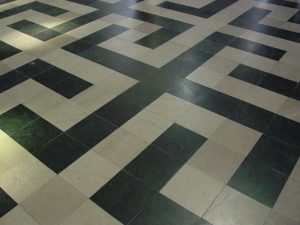
Another effect of wearing the swastika has been a variety of reactions from people who happen to notice the design. Typically, the first queestion I get is "Is that a swastika on your hand?!" which sets me off on a little lecture about the origins of the swastika and the purpose of my wearing it. I usually get a sigh of relief in return, aside from a small number of people who were already familiar with the pre-WWII swastika. One such person was a friend of mine from Athens, Greece. He informed me that the flooring tiles in his high school were decorated with swastikas, and that his school was "too cheap" to get them replaced. Initially I thought this was incredibly funny, but then I began to wonder if the students of that school, or members of communities in which some architecture contains swastikas, are less offended by the sign because of their constant exposure to it. I'm working on figuring that one out still :o)
So I think that the swastika will stay for a few more days before I decide to let it fade for good. I am incredibly glad that I decided to apply it in the first place, though. That such a small thing could have such a huge impact on my way of thinking amazes me. I still encourage you to try it. No, seriously. Come on, I know there's a pen within reach...give it a shot.
Another effect of wearing the swastika has been a variety of reactions from people who happen to notice the design. Typically, the first queestion I get is "Is that a swastika on your hand?!" which sets me off on a little lecture about the origins of the swastika and the purpose of my wearing it. I usually get a sigh of relief in return, aside from a small number of people who were already familiar with the pre-WWII swastika. One such person was a friend of mine from Athens, Greece. He informed me that the flooring tiles in his high school were decorated with swastikas, and that his school was "too cheap" to get them replaced. Initially I thought this was incredibly funny, but then I began to wonder if the students of that school, or members of communities in which some architecture contains swastikas, are less offended by the sign because of their constant exposure to it. I'm working on figuring that one out still :o)
So I think that the swastika will stay for a few more days before I decide to let it fade for good. I am incredibly glad that I decided to apply it in the first place, though. That such a small thing could have such a huge impact on my way of thinking amazes me. I still encourage you to try it. No, seriously. Come on, I know there's a pen within reach...give it a shot.
Monday, February 13, 2006
generation x - maybe the x is for eXceptional workers!
Why do the majority of people in older generations so despise body modification? Is it because they want to somehow ‘protect’ us youngens? Or maybe because they have been too long exposed to the cultural stigmas attached to body modification? In any case, negative feelings toward piercings and tattoos DO exist, despite the lack of any real reason for such attitudes. For example, I found an informational article on SchoolNurse.com that gives advice on how to prevent high school students from acquiring tattoos and piercings. Although the article claims to help nurses present information to students “in an objective way,” it is obviously anti-modification in its reference to “scare tactics” to deter students from modifying, and to the “pathological” nature of scarification.
In pondering on this subject this past weekend, I decided to talk to my mom about her feelings on body modification. Similar conversations have taken place in my family before, as I have had 18 piercings and 2 tattoos, but with much less structure and much more yelling. The difference this time was my focus on listening to my mom rather than telling her why she shouldn’t be so angry with me because of my appearance. Not that this single conversation has any direct correlation to the thoughts of all anti-mod adults, but it was still interesting to hear someone try to explain feelings that (I think) have no real justification. The only real reason my mom could come up with for why she hates my mods so much is that she's worried about my safety. So then why the feelings of anger and disgust rather than worry and concern? I am currently forbidden (at 20 years old) to get any more modifications, with the threat of having my college education ripped out from under me. So after the conversation with my mom, I could only attribute her negative feelings to a desire for her daughter to fit cultural norms. I don’t blame her for this, as it was not her fault that she was brought up by a family in which interracial dating was forbidden and non-conformists were seen as ‘freaks.’
My corset piercing! Not exactly a favorite of my parents, but certainly one of mine.
Okay, so enough rambling about my less-than-perfect relationship with my parents. The real issue I’m trying to get at is WHY it is so damn difficult to get a job with visible mods. I’ve heard things like “it scares the older customers” or “it’s not appropriate for the work environment,” both of which I do respect because it is ultimately the company’s decision as to who they are going to hire. On the other hand, however, companies can’t discriminate against a flamboyantly homosexual applicant just because the older customers may be turned off by his/her appearance, or against a black applicant because many of the customers of a certain company have been found to be racist. I realize we don’t live in a perfect world, but after all of this evolution, don’t you think we would have learned to judge people on their abilities rather than their appearances? I just don’t get it.
Sunday, February 12, 2006
Wow, is that new shading on your tat? Oh no, it's just cigarette ash...
When I step into a piercing and/or tattoo shop, I expect it to be BEYOND clean. That includes use of all the usual sterilization equipment, single-use needles, and protective gloves. But what if you found yourself in a tattoo shop filled with over 4,000 types of toxins in the air? Would you still want to have an open wound created in this environment, or would you opt for a cleaner establishment? Although safety and health are sometimes disregarded by extreme modifiers, those on the search for a simple lip piercing or a tattoo should be wary of a shop that subjects them to easily-avoidable health risks. One of these risks is cigarette smoke, which does indeed contain over 4,000 toxins.
The reason for my interest in the subject of cigarette smoking in tattoo and piercing shops is a place in Tel Aviv, Israel called Kipod. Kipod (which is Hebrew for "porcupine" - cute, no?) is a joint coffee shop and tattoo/piercing parlor. Sounds like a great hangout for someone like myself, who loves both coffee and body modification. But when I researched Kipod a bit on the Internet, I found some slightly disturbing photos from its grand opening party.
Maybe it’s because I’m a smoker myself, and not used to smoking indoors, but the sight of people smoking cigarettes in a tattoo shop bothered me quite a bit. Although smoking inside is quite the pleasure for most smokers, I understand that some people just hate the lingering smell and the health risks so it isn’t polite to smoke in public places. I also realize that cigarettes are a part of the culture in many countries, and that smoking indoors is considered completely normal, but a tattoo shop isn’t just any normal establishment. I can’t help but feel that smoking in what’s supposed to be a sterile environment is never appropriate, however pleasurable it might be. Would you trust a doctor who allowed smoking in his office?


Wednesday, February 08, 2006
Another great reason to go to Malaysia...
When I think of culturally significant body modification rituals, I always picture some ancient peoples with saucer-sized lip plates and beautiful scarification designs adorning their bodies. But today I found a Malaysia National News Agency article that refers to a modern mod-related cultural festival to be held this Saturday in Penang, Malaysia.
Participants in the Thaipusam festival perform a number of body modifications in order to show their appreciation for the grace of Lord Murugan, a Hindu god. Some of the modifications performed include cheek, lip, and tongue skewering, placing metal hooks connected to weights on the back, and wearing kavadis (apparatus fixed with sharp spikes that dig into the skin when it is worn). Other worshippers show their faith and appreciation by simply carrying jugs of milk from a site in Lebuh, Penang 10 kilometers to the Nattukottai Chettiar Temple in Jalan Kebun Bunga. Don’t think it’s just they guys who modify for the sake of religion, though. Many women, such as the one below, participate as well.

I couldn’t help but let out a self-righteous giggle when I read another article about the Thaipusam, which expressed utter awe at the various modification rituals performed, apparently unaware that similar ones are done for non-religious purposes in the West. The article also claims that the participants of Thaipusam magically never bleed during their acts of faith. This was an odd statement for a number of reasons: 1) Cheek piercings often don’t bleed (although they sometimes do, it's no miracle that many Thaipusam cheek skewers didn't) 2) Most kavadis only subject the wearer to a number of sharp, non-penetrating pokes 3) The hooks that are said to be “pierced” through the skin are actually just hung securely on outstretched skin 4) I have found pictures of Thaipusam participants bleeding as a result of lip and other piercings. Sorry, I just love proving news articles wrong, especially when they have to do with body modification :o)
After checking out some information on same-day passports and airfare to Malaysia, I decided it wasn’t really a possibility for me to experience the festival first hand this year. I guess I’ll have to wait for the next full moon in the 10th Tamil month of Thai. Whenever that is...
Participants in the Thaipusam festival perform a number of body modifications in order to show their appreciation for the grace of Lord Murugan, a Hindu god. Some of the modifications performed include cheek, lip, and tongue skewering, placing metal hooks connected to weights on the back, and wearing kavadis (apparatus fixed with sharp spikes that dig into the skin when it is worn). Other worshippers show their faith and appreciation by simply carrying jugs of milk from a site in Lebuh, Penang 10 kilometers to the Nattukottai Chettiar Temple in Jalan Kebun Bunga. Don’t think it’s just they guys who modify for the sake of religion, though. Many women, such as the one below, participate as well.
I couldn’t help but let out a self-righteous giggle when I read another article about the Thaipusam, which expressed utter awe at the various modification rituals performed, apparently unaware that similar ones are done for non-religious purposes in the West. The article also claims that the participants of Thaipusam magically never bleed during their acts of faith. This was an odd statement for a number of reasons: 1) Cheek piercings often don’t bleed (although they sometimes do, it's no miracle that many Thaipusam cheek skewers didn't) 2) Most kavadis only subject the wearer to a number of sharp, non-penetrating pokes 3) The hooks that are said to be “pierced” through the skin are actually just hung securely on outstretched skin 4) I have found pictures of Thaipusam participants bleeding as a result of lip and other piercings. Sorry, I just love proving news articles wrong, especially when they have to do with body modification :o)
After checking out some information on same-day passports and airfare to Malaysia, I decided it wasn’t really a possibility for me to experience the festival first hand this year. I guess I’ll have to wait for the next full moon in the 10th Tamil month of Thai. Whenever that is...
Tuesday, February 07, 2006
Pain CAN be fun
So the past few entries I've posted have been a bit...scholarly. Which is why I thought it would be helpful to mention that I'm writing this blog primarily for my personal interest in body modification, but also because it's counting as part of my independent study course this semester. Not that you should care or anything, but I just wanted everyone to know why I've been so formal in my first entries. BUT! after meeting with my professor and discussing the posts I've made so far, I think that I can loosen up a bit and have some more fun with this blog. SO! be prepared for some new and improved posts starting weds. - you will not be disappointed, trust me.
Oh, and by the way, has anyone actually drawn a swastika on their skin as I recommended? I did today, and got quite a few odd looks, but no one has approached me about it yet. I think I'm going to re-draw it every day until I get to have at least a few conversations about it - either that or until I get jumped by a clan of kids from my school's Hillel chapter. Night everyone, and be sure to check back tomorrow for some interesting tidbits.
Oh, and by the way, has anyone actually drawn a swastika on their skin as I recommended? I did today, and got quite a few odd looks, but no one has approached me about it yet. I think I'm going to re-draw it every day until I get to have at least a few conversations about it - either that or until I get jumped by a clan of kids from my school's Hillel chapter. Night everyone, and be sure to check back tomorrow for some interesting tidbits.
Sunday, February 05, 2006
Update...
I was working in my dorm room last night with the television on as background noise when a news update happened to catch my attention. Police had been searching diligently for the New Bedford resident that I mentioned in yesterday's post, who fled MA after his brutal attack earlier this week on 3 gay bar patrons. Unfortunately, rather than yielding relief and closure at the teen's arrest, the ending of this story disturbed me even more so than the beginning. The assailant was reportedly recognized by an officer at a traffic stop 1,500 hundred miles from the location of the original incident. Upon being approached by this Gassville, AK officer, the criminal shot and killed him. Shortly after, a shootout occurred between officers and the teen in which both he and his passenger, a West Virginia woman, were fatally injured.
Okay, let me get this straight. Some Nazi-worshipping teen just sliced up and shot 3 men in a hate crime attack, then killed an innocent police officer, and lost his own life and that of a woman who was in his car. To top it all off, he was a tattooed individual donning the tainted swastika symbol. This disturbed teen has simultaneously contributed to the belief that tattoos=delinquincy and helped to preserve misinformed attitudes regarding the swastika symbol. In wondering if Man Woman was aware of this story, I decided to e-mail him some information on it.
With this recent development at hand, I once again urge my readers to reverse the hate, and rectify incorrect beliefs. Word of mouth spreads quickly, so don't ever assume that your actions don't matter.
Okay, let me get this straight. Some Nazi-worshipping teen just sliced up and shot 3 men in a hate crime attack, then killed an innocent police officer, and lost his own life and that of a woman who was in his car. To top it all off, he was a tattooed individual donning the tainted swastika symbol. This disturbed teen has simultaneously contributed to the belief that tattoos=delinquincy and helped to preserve misinformed attitudes regarding the swastika symbol. In wondering if Man Woman was aware of this story, I decided to e-mail him some information on it.
With this recent development at hand, I once again urge my readers to reverse the hate, and rectify incorrect beliefs. Word of mouth spreads quickly, so don't ever assume that your actions don't matter.
Saturday, February 04, 2006
Free the swastika!
In trying to keep up with local Massachusetts news while at school, I came upon a story today that involves a recent attack on several gay bar patrons by an accused Nazi follower. The 18 year-old attacker is reported to have a swastika tattooed on his hand and a bedroom filled with Nazi paraphernalia. Hearing this story immediately reminded me of a section I had recently read in Modern Primitives on an artist who goes by the name Man Woman.
Although both Man Woman and the disturbed teenager from the news story sport tattoos depicting the swastika symbol, the meanings of such are in sharp contrast to one another. Many people immediately associate the swastika symbol with the terrors of Nazi Germany during WWII, ignorant of the fact that swastikas have been used by a wide array of cultures as a pure and benevolent symbol for hundreds of years. Man Woman is part of a loosely organized group called the Friends of the Swastika, whose goal it is to educate the rest of the world about the innocent nature of the swastika symbol and how it has been perverted by the evil values of anti-Semitism.
Man Woman’s personal contribution to this effort is his collection of several hundred swastika tattoos derived from “every culture and religion on the face of the earth” (V. Vale, Modern Primitives pp.42). He also collects pre-WWII memorabilia that contain some form of the swastika as it was used to represent things ranging from the sun to divine enlightenment, and hopes to showcase these items in an educational tour or museum show in the future. I'm incredibly intrigued by the interview with Man Woman, and how he describes the process of “stripping away false education [...]; false attitudes” that he received during the early years of his life. I love the concept of realizing that the norms we have come to accept are not ultimate truths, because one deconstruction of this sort seems to set off a chain reaction that eventually leads to a completely new outlook on the world. I also enjoyed Man Woman’s response to questions concerning the reactions he has received to his seemingly offensive ink scheme: “The people who won’t talk to me because of my tattoos are probably people I don’t want to talk to. And the ones who spot me in a crowd and come running over – sometimes I meet interesting people that way” (V. Vale, Modern Primitives pp.43).
More information on the origins and various occurrences of the swastika in its benign forms can be found in Thomas Wilson’s 1894 essay, Swastika: the Earliest Known Symbol and Its Migration. This particular resource was recommended by Man Woman as an excellent source for anyone wishing to learn more about the swastika and rid themselves of the subconscious association with evil that it has unfairly acquired.
Sadly enough, confused youngsters like the New Bedford teen mentioned above only help to perpetuate the kind of ignorance that Man Woman has spent the majority of his life trying to eradicate. I suggest that we all try to do Man Woman a favor: after you have read this post, take a Sharpie and draw a version of the swastika on a visible area of your body. I know that this may sound like dangerous advice, and please follow it only at your own risk, but you will likely be surprised at how many comments and inquiries you receive. And when one of those know-it-all types object to your donning of what they perceive to be a symbol of evil and hatred, you can find satisfaction in correcting their ignorance.
Although both Man Woman and the disturbed teenager from the news story sport tattoos depicting the swastika symbol, the meanings of such are in sharp contrast to one another. Many people immediately associate the swastika symbol with the terrors of Nazi Germany during WWII, ignorant of the fact that swastikas have been used by a wide array of cultures as a pure and benevolent symbol for hundreds of years. Man Woman is part of a loosely organized group called the Friends of the Swastika, whose goal it is to educate the rest of the world about the innocent nature of the swastika symbol and how it has been perverted by the evil values of anti-Semitism.

Man Woman’s personal contribution to this effort is his collection of several hundred swastika tattoos derived from “every culture and religion on the face of the earth” (V. Vale, Modern Primitives pp.42). He also collects pre-WWII memorabilia that contain some form of the swastika as it was used to represent things ranging from the sun to divine enlightenment, and hopes to showcase these items in an educational tour or museum show in the future. I'm incredibly intrigued by the interview with Man Woman, and how he describes the process of “stripping away false education [...]; false attitudes” that he received during the early years of his life. I love the concept of realizing that the norms we have come to accept are not ultimate truths, because one deconstruction of this sort seems to set off a chain reaction that eventually leads to a completely new outlook on the world. I also enjoyed Man Woman’s response to questions concerning the reactions he has received to his seemingly offensive ink scheme: “The people who won’t talk to me because of my tattoos are probably people I don’t want to talk to. And the ones who spot me in a crowd and come running over – sometimes I meet interesting people that way” (V. Vale, Modern Primitives pp.43).
More information on the origins and various occurrences of the swastika in its benign forms can be found in Thomas Wilson’s 1894 essay, Swastika: the Earliest Known Symbol and Its Migration. This particular resource was recommended by Man Woman as an excellent source for anyone wishing to learn more about the swastika and rid themselves of the subconscious association with evil that it has unfairly acquired.
Sadly enough, confused youngsters like the New Bedford teen mentioned above only help to perpetuate the kind of ignorance that Man Woman has spent the majority of his life trying to eradicate. I suggest that we all try to do Man Woman a favor: after you have read this post, take a Sharpie and draw a version of the swastika on a visible area of your body. I know that this may sound like dangerous advice, and please follow it only at your own risk, but you will likely be surprised at how many comments and inquiries you receive. And when one of those know-it-all types object to your donning of what they perceive to be a symbol of evil and hatred, you can find satisfaction in correcting their ignorance.
Thursday, February 02, 2006
Village idiots?
This being my first real entry, I thought it would be most appropriate to start at the beginning. That is, in this week’s posts I will explore the history of body modification to give contemporary modifiers a sense of its various past significances. It is my hope that this information will provide those new to body modification with a different perspective on the extraordinary meaningfulness of permanently altering one’s body.
Among the many rituals enacted by Native Americans and other indigenous peoples for the purpose of appeasing a variety of gods and sacred deities is the practice commonly referred to as body suspension. Although most modern body suspensions differ dramatically from these ceremonies both in method and meaning, suspensions in general have been reported to often produce trance-like states in individuals undergoing the rituals. There are a number of different types of suspensions, ranging from so-called ‘suicide’ suspensions in which the participant is hung vertically by two to four metal hooks pierced through the upper back, to the Faulkner suspension which involves hanging upside-down from hooks placed in the skin just above the knees. Another form of suspension, often referred to as a vertical chest suspension, or an O-Kee Pa suspension, originated in the Mandan tribe of present-day North and South Dakota. Many modern suspension teams deem the use of the term “O-Kee Pa” for any kind of vertical chest suspension a cultural appropriation because it was originally used as a sacred ritual intended to pay homage to the food and water gods and gain holy approval in the selection of new leaders. The suspension itself was only one feature of the O-Kee Pa ritual, which also included a number of religious dances and a four-day vigil held without food, water, or sleep.
 After the four days had passed, those undergoing the suspension itself were pierced through the chest with sharp wooden skewers attached to ropes hung over a large wooden frame. The ropes were then pulled as to suspend each man (women were not even allowed to watch this ceremony) from the frame. Each individual suspension lasted until the participant had lost consciousness, at which time he was removed from the frame and guarded until coming-to. The final stage of the ceremony involved the amputation of one or both pinky fingers by a medicine man, and an exhausting sprint around the village. Those Mandans who completed the entire ritual received a great deal of praise from the rest of the tribe, and those who completed it most courageously were given special consideration in the selection of new leaders.
For the Mandans, the O-Kee Pa ritual was an intense test of courage and devotion to the tribe. The exhilaration of completing such a ceremony as well as the transient state achieved during such surely served as additional rewards. O-Kee Pa is an early textbook example of the physical pain that body modifiers will endure in order to reap the spiritual and life-changing benefits of such extreme practices.
If you enjoyed this post, check back next week when I will contrast culturally significant rituals such as O-Kee Pa suspension with modern suspension practices to see how the meanings behind them differ.
Please comment if you read this! I want to hear suggestions, criticism; anything you can contribute will be greatly appreciated!
Among the many rituals enacted by Native Americans and other indigenous peoples for the purpose of appeasing a variety of gods and sacred deities is the practice commonly referred to as body suspension. Although most modern body suspensions differ dramatically from these ceremonies both in method and meaning, suspensions in general have been reported to often produce trance-like states in individuals undergoing the rituals. There are a number of different types of suspensions, ranging from so-called ‘suicide’ suspensions in which the participant is hung vertically by two to four metal hooks pierced through the upper back, to the Faulkner suspension which involves hanging upside-down from hooks placed in the skin just above the knees. Another form of suspension, often referred to as a vertical chest suspension, or an O-Kee Pa suspension, originated in the Mandan tribe of present-day North and South Dakota. Many modern suspension teams deem the use of the term “O-Kee Pa” for any kind of vertical chest suspension a cultural appropriation because it was originally used as a sacred ritual intended to pay homage to the food and water gods and gain holy approval in the selection of new leaders. The suspension itself was only one feature of the O-Kee Pa ritual, which also included a number of religious dances and a four-day vigil held without food, water, or sleep.
After the four days had passed, those undergoing the suspension itself were pierced through the chest with sharp wooden skewers attached to ropes hung over a large wooden frame. The ropes were then pulled as to suspend each man (women were not even allowed to watch this ceremony) from the frame. Each individual suspension lasted until the participant had lost consciousness, at which time he was removed from the frame and guarded until coming-to. The final stage of the ceremony involved the amputation of one or both pinky fingers by a medicine man, and an exhausting sprint around the village. Those Mandans who completed the entire ritual received a great deal of praise from the rest of the tribe, and those who completed it most courageously were given special consideration in the selection of new leaders.For the Mandans, the O-Kee Pa ritual was an intense test of courage and devotion to the tribe. The exhilaration of completing such a ceremony as well as the transient state achieved during such surely served as additional rewards. O-Kee Pa is an early textbook example of the physical pain that body modifiers will endure in order to reap the spiritual and life-changing benefits of such extreme practices.
If you enjoyed this post, check back next week when I will contrast culturally significant rituals such as O-Kee Pa suspension with modern suspension practices to see how the meanings behind them differ.
Please comment if you read this! I want to hear suggestions, criticism; anything you can contribute will be greatly appreciated!
Tuesday, January 31, 2006
Why, oh, why??
Although I have come upon a number of fascinating blogs that address the various aspects of tattoo culture, other forms of body modification seem to lack attention. This seems quite backwards to me, as a plethora of information regarding tattoos can be found by simply "Googling" pertinent terms, but it is substantially more difficult to encounter websites devoted to informing and stimulating the minds of those interested in such less mainstream forms of body modification as scarification and suspension. In response to my rather fruitless quest (BMEzine notwithstanding) for an informational resource that encompasses all forms of body modification, not just tattoos, I have decided to start my own. In creating this blog I hope to educate myself as much as possible on the many aspects of body modification, share the information that I acquire to educate others (both modifiers themselves and the lay public), and have an open space in which I can develop my skills as an aspiring journalist. In addition, I blog in the hope that I can change some beliefs regarding the “type of people” who undergo the various forms of body modification. Our culture seems to me to be focused on the idea that pristine skin and a put-together appearance represent beauty, intelligence, and kindness. In response to this all-too-common view, I present myself as proof that it is possible to be pierced, tattooed, branded, and clad in unconventional clothing, and still be just as beautiful, intelligent, and kind as any smartly dressed, flawlessly-skinned individual. If you are one of the open-minded individuals who have already realized that cultural assumptions do not always hold true, kudos. If not, I hope you will take some time to explore my blog and see that there is more to body modification than shock-value and rebellion. Modified people have families, friends, and feelings just like everyone else. The only difference is that our hobbies involve needles and blood rather than balls and cleats. Well, on second thought, having balls is rather essential...
Subscribe to:
Posts (Atom)

 Posts
Posts


